


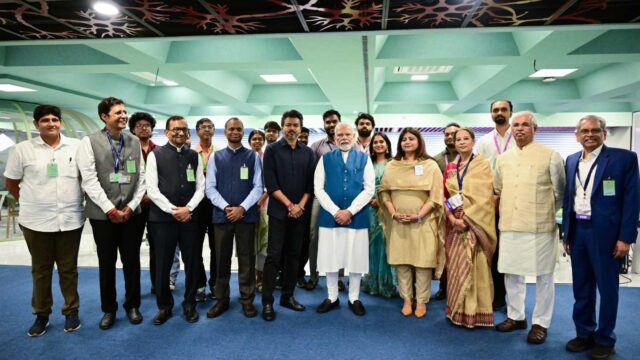
IIT Madras’ Sudha Gopalakrishnan Brain Centre (SGBC) has launched a mission to create three-dimensional, cell-resolution maps of 100 human brains spanning the entire lifespan, from the foetal stage to old age, including brains affected by diseases.
Prime Minister Narendra Modi kicked off the scientific initiative on Sunday, marking a major step in India’s efforts to advance neuroscience through high-resolution brain imaging, computing and medical research.
The project aims to build the largest collection of three-dimensional maps of whole human brains at cellular resolution. The resulting atlases will be made publicly accessible to researchers, medical professionals and others worldwide through a digital platform for image visualisation and computing.
The initiative combines brain science, engineering, medicine and advanced computing to provide a deeper understanding of the human brain and the cellular mechanisms underlying neurological diseases.
200 researchers and 10 medical institutions involved
The global research mission is being led by SGBC and involves more than 200 researchers, engineers and technicians at the centre, over 10 medical institutions across India and 30 leading researchers from more than 10 countries.
The centre uses a high-throughput brain imaging and computing platform to process whole post-mortem human brains into digital three-dimensional maps at cellular resolution.
By making these maps available through an open-access framework, the initiative seeks to enable researchers to examine brain structures and disease processes at an unprecedented level of detail.
The maps are expected to support investigations into neurological conditions, help researchers identify disease mechanisms and potentially open new avenues for diagnosis and treatment.
C-STROKE maps cellular changes in stroke-affected brain
As part of the initiative, Modi released C-STROKE, described by IIT Madras as the world’s first human ischaemic stroke atlas.
The atlas bridges millimetre-scale magnetic resonance imaging (MRI) scans taken before death with microscopic, whole-brain histology at micron resolution. This allows researchers to connect clinical imaging findings with the underlying cellular changes in stroke-affected brain tissue.
C-STROKE contains more than 1,000 annotated brain sections from a stroke-affected brain. It maps key cellular indicators, including neuronal health, neuroinflammation, disruption of the blood-brain barrier, hypoxia and axonal injury.
These features enable researchers to investigate the cellular basis of clinical imaging signatures, potentially improving the understanding of how ischaemic stroke damages brain tissue.
The atlas is accompanied by an open-access data viewer and analytical suite, allowing researchers and clinicians worldwide to examine cerebrovascular pathology across different spatial scales.
The platform is also intended to support the identification of potential therapeutic targets directly within human brain tissue.
Param Shakti supercomputer powers brain mapping
The three-dimensional brain maps were generated using the Param Shakti supercomputer, supported by the Ministry of Electronics and Information Technology (MeitY).
The use of advanced computing is central to processing the enormous volumes of imaging data required to reconstruct whole human brains at cellular resolution.
The combination of specialised imaging systems, computing infrastructure and multidisciplinary expertise enables the centre to create detailed digital representations of brain tissue that can be studied by researchers across geographical boundaries.
The planned collection of 100 brain atlases will extend this approach across different stages of human life and include disease-affected brains, creating a resource for comparative studies of brain development, ageing and neurological disorders.
Philanthropic support backs advanced brain research
The research initiative is supported by Prem Watsa, distinguished alumnus of IIT Madras and chairman of Fairfax Financial.
IIT Madras Distinguished Alumnus and Infosys co-founder Kris Gopalakrishnan, who played a key role in establishing SGBC and is a major donor to the centre, said the Prime Minister’s visit would inspire scientists working on the mission.
He also expressed hope that the initiative would encourage philanthropists to support and scale up world-class scientific research in India.
SGBC Head Mohanasankar Sivaprakasam said the centre was privileged to have the Prime Minister launch a mission bringing together brain sciences, engineering, medicine and technology.
He said the brain maps and atlases could have significant implications for neuroscience and neuromedicine over the coming decades.
Open-access research could widen global collaboration
The initiative’s public-access approach is intended to make advanced human brain imaging data available to a wider research community, enabling scientists to investigate questions that would be difficult to address through conventional imaging alone.
By connecting clinical MRI findings with cellular-level evidence, C-STROKE provides a framework for examining the biological processes behind stroke-related brain damage.
The broader mission to map 100 human brains could also help researchers compare healthy and diseased tissue, study changes across the lifespan and explore potential targets for future therapies.
For India, the project underscores the growing role of domestic research institutions in developing advanced scientific infrastructure and contributing to global biomedical research.