


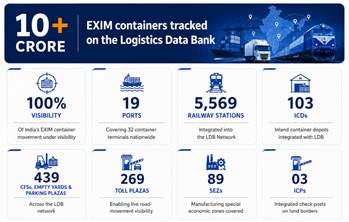
The Logistics Data Bank (LDB), India’s technology-enabled platform for tracking EXIM container movement, has crossed a major milestone by tracking 10 crore export-import containers since its launch in 2016.
The platform provides visibility of container movement across India’s logistics network, enabling stakeholders to monitor shipments, assess performance and identify bottlenecks across the logistics chain.
Commerce and Industry Minister Piyush Goyal said the tracking of 10 crore containers through the LDB marked an important milestone in India’s logistics journey.
He said technology was helping make logistics simpler, faster and more efficient while improving the competitiveness of Indian industry.
“Efficient logistics will be central to strengthening manufacturing, expanding our presence in global markets and realising the Hon’ble Prime Minister’s vision of a Viksit Bharat,” Goyal said.
100% EXIM container visibility
LDB provides visibility of 100% of India’s EXIM container movement using RFID-based technology.
Its network currently covers 19 ports and 32 container terminals, besides extending to 103 Inland Container Depots (ICDs), 439 Container Freight Stations (CFSs), Empty Yards, Parking Plazas and Industrial Zones.
The platform also covers 89 Manufacturing Special Economic Zones, 5,569 railway stations, 269 toll plazas and three Integrated Check Posts, creating a technology-enabled tracking network across multiple modes of transport.
LDB uses Radio Frequency Identification (RFID), Internet of Things (IoT), Big Data and cloud technologies to track containers across ports, rail networks, industrial zones, borders and highways.
LDB 2.0 adds multimodal visibility
The platform’s capabilities were expanded with the launch of LDB 2.0 in September 2025, which introduced high-seas tracking of India’s export containers and enhanced multimodal shipment visibility.
LDB also provides analytics on dwell time, transit time and port and terminal performance, helping logistics stakeholders monitor operations and identify potential bottlenecks.
The World Bank’s Logistics Performance Index has also recognised the role of the Logistics Data Bank in India’s logistics performance.
1.5 crore searches every month
The scale of usage has grown alongside the platform’s coverage. LDB records an average of more than 1.5 crore container searches every month, with tracking services available through its single-window platform.
National Industrial Corridor Development Corporation, CEO and Managing Director, and NICDC Logistics Data Services Limited, Chairman, Rajat Kumar Saini, said crossing the 10-crore container milestone was a significant achievement for LDB.
He said the platform had evolved from its original objective of providing visibility of EXIM container movement into an important digital infrastructure platform for India’s logistics sector.
Saini said the achievement was supported by cooperation from the Ministry of Ports, Shipping and Waterways, Ministry of Road Transport and Highways, ports, terminals, CFSs, ICDs and other stakeholders.
He added that NLDSL would focus on strengthening LDB through analytics and new technologies to address the evolving requirements of India’s logistics sector.
Digital backbone for logistics
NICDC Logistics Data Services Ltd (NLDSL) develops logistics technology solutions including the Logistics Data Bank and Unified Logistics Interface Platform (ULIP). The platforms use digital technologies to improve efficiency, transparency and digitisation across India’s logistics ecosystem.
NLDSL was established on December 30, 2015, to harness information and communication technology for improving efficiency in India’s logistics sector. It is a joint venture between the Government of India, represented by the National Industrial Corridor Development and Implementation Trust (NICDIT), and Japanese technology major NEC Corporation.
The tracking of 10 crore containers underscores the growing role of digital infrastructure in India’s logistics ecosystem as the country seeks to lower logistics costs, improve supply-chain visibility and strengthen its position in global trade.