


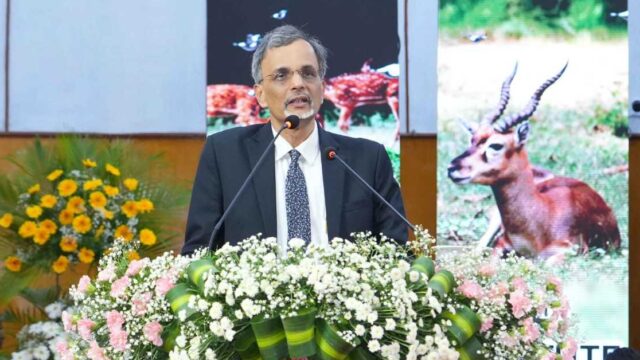
The next two decades are likely to witness a period of geopolitical uncertainty and global realignment similar to the years between 1925 and 1945, Chief Economic Advisor (CEA) Dr V Anantha Nageswaran has cautioned, urging businesses, policymakers and educational institutions to prepare for a more volatile and complex world.
Speaking on the latest episode of the Professor Mahesh Podcast, an initiative of IITM Global at IIT Madras, Dr Nageswaran outlined his views on global stability, artificial intelligence (AI), India’s economic resilience and the evolving demands of higher education.
Geopolitical volatility ahead
Dr. Nageswaran said the world is entering a prolonged period of geopolitical churn that could fundamentally reshape global trade, supply chains and economic strategies.
“The next 20 years will mimic to some extent the period between 1925 and 1945,” said Dr Nageswaran.
He noted that corporations can no longer focus solely on efficiency-driven models and must increasingly prioritise resilience and security as countries use supply chains, technology and financial systems as strategic tools in global competition.
According to the CEA, the shift from “just-in-time” to “just-in-case” business models is likely to become a defining feature of the global economy over the coming years.
India’s strategic strengths
Highlighting India’s inherent strengths, Dr Nageswaran said the country’s capabilities are often underestimated.
He pointed out that India is among a handful of nations globally capable of simultaneously maintaining food self-sufficiency, launching satellites through indigenous capabilities and manufacturing essential pharmaceutical products such as antibiotics and paracetamol.
The combination of these capabilities provides India with a significant strategic advantage at a time when countries are increasingly prioritizing self-reliance and supply chain security.
AI to reshape work, not replace thinking
On artificial intelligence, Dr Nageswaran argued that AI is unlikely to reduce the cognitive burden on individuals and may instead increase the need for critical thinking and decision-making.
He stressed the growing importance of prompt engineering and effective human interaction with AI systems.
“If your prompt is garbage, the output is garbage,” he observed, emphasising that human judgment will remain critical even in an AI-driven world.
The CEA also identified trade skills such as electrical work, plumbing and mechanical services as areas likely to remain relatively insulated from AI-led disruption, creating significant economic opportunities in the years ahead.
India’s economic paradox
Describing India as a unique economic experiment, Dr Nageswaran referred to the well-known observation attributed to economist Joan Robinson that “whatever you say about India, the opposite can also be true.”
He said India remains a “living economics laboratory” where large-scale socio-economic transformation is being pursued within a democratic framework even before the country has attained full economic prosperity.
According to him, this makes India’s development journey distinct from that of most advanced economies.
Formalisation gathers pace
The CEA also highlighted the rapid formalisation of the Indian economy, particularly following the implementation of the Goods and Services Tax (GST).
He noted that a growing number of micro, small and medium enterprises (MSMEs) have moved into the formal economy, significantly improving transparency and economic participation.
According to internal assessments cited by Dr Nageswaran, nearly 65% of India’s economy is now formalised, marking a substantial structural shift over the past decade.
New priorities for higher education
Dr. Nageswaran urged educational institutions to rethink traditional academic approaches and place greater emphasis on interdisciplinary learning.
He said studying engineering, computer science or other technical disciplines in isolation may no longer be sufficient in an increasingly interconnected and unpredictable world.
A deeper understanding of economics, history, public policy and political economy will become essential for students seeking to navigate future challenges and opportunities, he added.
Preparing for a changing world
The discussion highlighted the growing need for governments, businesses and academic institutions to adapt to a world shaped by geopolitical competition, technological disruption and economic transformation.
For India, Dr Nageswaran suggested that resilience, self-sufficiency, skills development and interdisciplinary education will be key pillars supporting long-term growth and competitiveness.