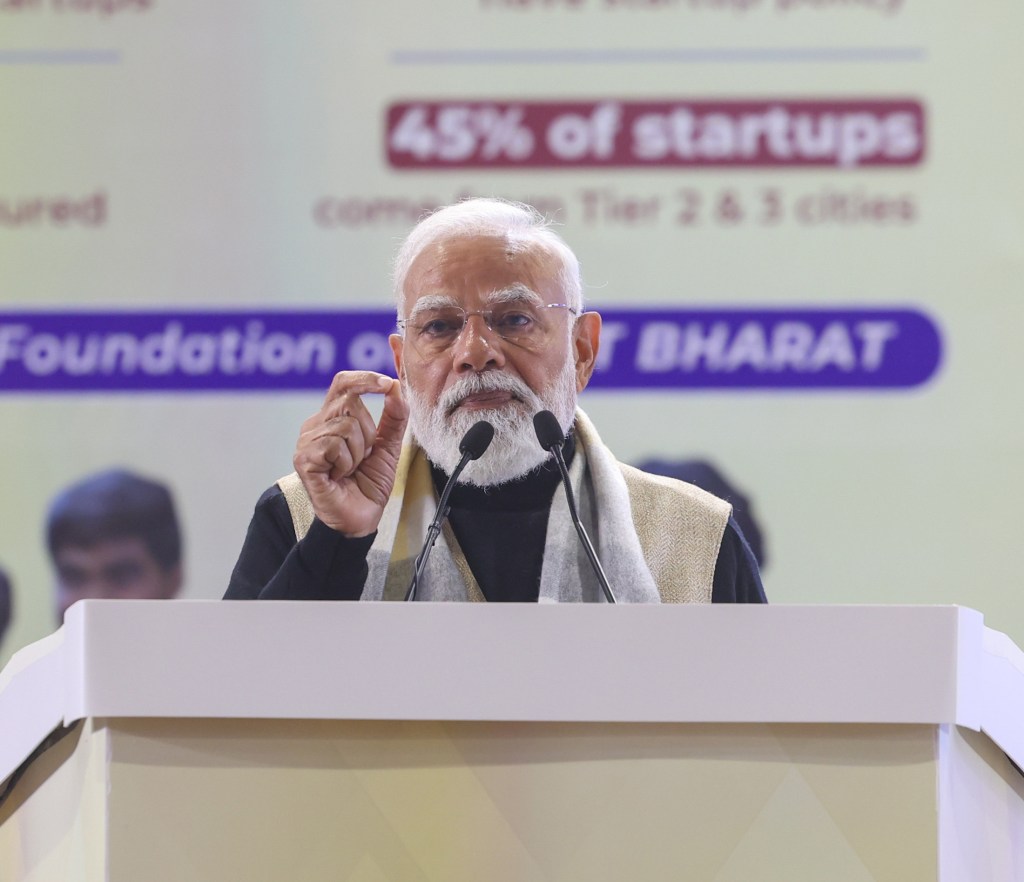
Prime minister Narendra Modi said that Startup India has given birth to a new culture in the country even as the programme has helped the youth from tier-2, tier-3 cities and villages, to launch their own startups, attempting to solve the most pressing grassroots problems.
Earlier, new businesses and ventures were largely initiated by children of big industrial families, as they alone had easy access to funding and support, while most middle-class and poor children could only dream of jobs. He highlighted that the Startup India programme has changed this mindset.
On the occasion of National Startup Day, Friday Modi addressed the programme marking a decade of the Startup India initiative at Bharat Mandapam, New Delhi.
He recalled that ten years ago there was little scope for individual efforts and innovation, but those circumstances were challenged and the Startup India programme was launched, giving youth an open sky, and today the results are before the nation. “In just 10 years, the Startup India Mission has become a revolution. Today, India is the world’s third-largest startup ecosystem”, said Modi.
He pointed out that ten years ago there were fewer than 500 startups in the country, while today the number has risen to more than 2 lakh. In 2014 India had only four unicorns, whereas today there are nearly 125 active unicorns. He further highlighted that the momentum of Startup India continues to accelerate, with today’s startups becoming unicorns, launching IPOs, and creating more and more jobs.
He stated that in the year 2025 alone, nearly 44,000 new startups were registered, the largest increase in any single year since the beginning of Startup India, and these figures testify to how India’s startups are driving employment, innovation, and growth.
He noted that daughters of the country have played a major role in this transformation, with more than 45% of recognised startups having at least one woman director or partner.
The Prime Minister highlighted that in the past ten years, the country has built an ecosystem that promotes innovation. Atal Tinkering Labs was established in schools to awaken the spirit of innovation among children, hackathons launched to encourage youth to solve national problems, and incubation centres created to ensure ideas do not die due to lack of resources.
“Startup India is not just a scheme, it is a rainbow vision connecting diverse sectors with new opportunities”, emphasised Modi. He pointed out that in defense manufacturing, startups could not even imagine competing with established players earlier, but through iDEX, new procurement pathways have been opened in strategic sectors. The space sector, once closed to private participation, has now been opened, with nearly 200 startups working in this field and gaining global recognition. Similarly, the drone sector, where outdated rules had long held India back, but reforms and trust in innovators have changed the landscape. In public procurement, the government e-Marketplace (GeM) has expanded market access, with nearly 35,000 startups and small businesses onboarded, receiving around 5 lakh orders worth approximately ₹50,000 crore.
Through the Fund of Funds for Startups, investments of more than ₹25,000 crore have been made, while schemes such as the Startup India Seed Fund, IN-SPACe Seed Fund, and NIDHI Seed Support Programme are providing seed funding to startups. To improve credit access, a Credit Guarantee Scheme has been launched so that lack of collateral does not become an obstacle to creativity.
Emphasising that today’s research becomes tomorrow’s intellectual property, i Modi said to promote this, a ₹1 lakh crore research, development and innovation scheme has been initiated, along with a deep tech fund of funds to support long-term investment in sunrise sectors.
The Prime Minister underlined the need to prepare for the future by working on new ideas in emerging domains that will play a crucial role in economic security and strategic autonomy, citing AI as a prime example. Nations leading in the AI revolution will have greater advantage, and for India this responsibility lies with its startups. Mentioning that India will host the AI Impact Summit in February 2026, he remarked that it was a great opportunity for the youth.
“India’s ambition should not be limited to participation but must aim for global leadership, urging startups to work on new ideas, solve problems”, stressed the Prime Minister. He remarked that in the past decades, India had its achievements in digital startups and service sectors and it was now time for startups to focus on the manufacturing sector. He called for the creation of new products of world-class quality and unique technological ideas to lead the future.

 Corpwhizz
Leave a comment