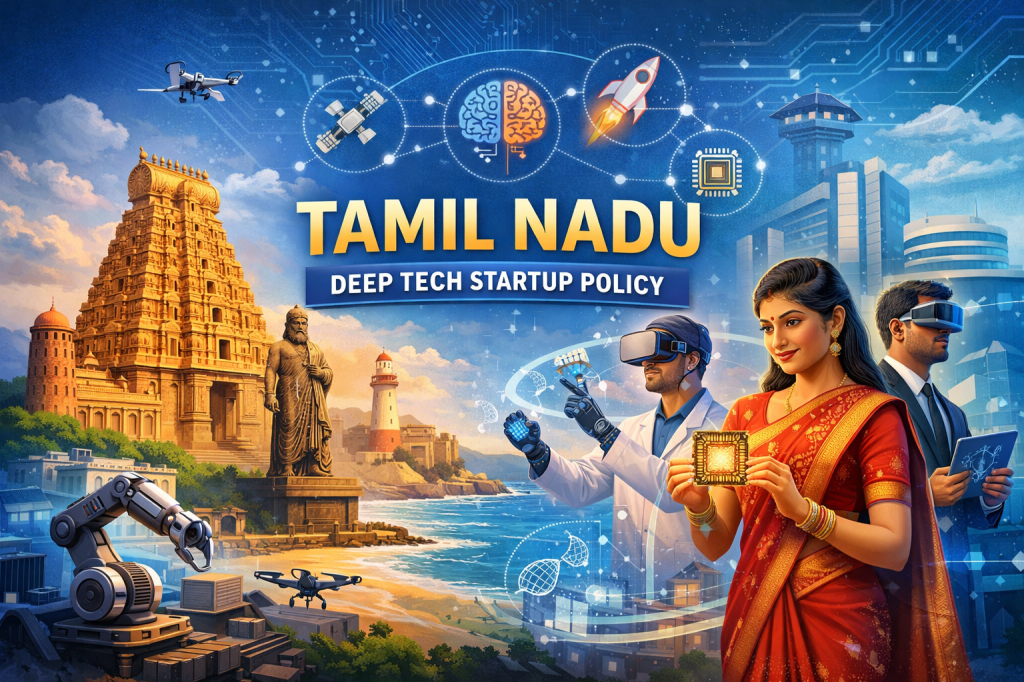
Tamil Nadu’s recently launched exclusive Deep Tech Startup Policy signals a deliberate course correction. Instead of treating deep tech as an extension of general startup policy, the state has carved out a tailor-made framework designed around the realities of hard technology innovation.
India’s startup ecosystem has long been dominated by consumer internet, SaaS, and fintech ventures. While these sectors delivered scale and speed, they often sidelined deep tech startups—ventures built on advanced science, engineering, and intellectual property, with longer development cycles and higher capital needs.
For founders, investors, and research institutions, this policy represents more than incentives—it reflects a structural rethinking of how governments can enable frontier innovation.
Why Deep Tech Needs a Different Policy Lens
Deep tech startups differ fundamentally from app-based or platform businesses. They typically involve:
- High upfront capital expenditure
- Regulatory and certification hurdles
- Dependence on specialised infrastructure and talent
- Strong reliance on intellectual property (IP)
Traditional startup policies—focused on incubation, pitch days, and seed grants—often fail to support these realities. Tamil Nadu’s policy stands out because it acknowledges these constraints upfront and attempts to design solutions around them.
Key Benefits for the Startup Community
One of the most significant benefits of the policy is its stage-aligned funding approach. Instead of one-time grants, support is linked to a startup’s technology readiness and commercial maturity.
This structure helps startups:
- Survive the “valley of death” between research and revenue
- Focus on engineering outcomes rather than short-term traction metrics
- Attract co-investment by lowering early-stage risk
For founders, this means less pressure to prematurely pivot and more freedom to build defensible technology.
Government as Early Customer Creates Real Market Pull
A chronic problem for deep tech startups is finding their first buyer. Tamil Nadu’s policy introduces a powerful lever: government departments acting as early adopters.
By enabling pilot deployments and proof-of-concept projects within public systems, the policy:
- Validates technology in real-world environments
- Provides critical credibility for future customers
- Shortens the sales cycle for enterprise and industrial markets
This demand-side support moves beyond subsidies and addresses one of deep tech’s hardest challenges—market access.
Infrastructure Access Lowers Capital Barriers
Deep tech innovation often requires expensive labs, test facilities, and prototyping environments. By strengthening shared infrastructure such as research parks, testing centres, and centres of excellence, the policy reduces the need for startups to build everything in-house.
This benefits the ecosystem by:
- Lowering entry barriers for first-time founders
- Encouraging experimentation without prohibitive costs
- Enabling collaboration between startups, academia, and industry
Over time, this shared infrastructure can become a competitive advantage for Tamil Nadu as a deep tech hub.
Strong Emphasis on Intellectual Property Creation
Unlike many startup policies that prioritise valuation and job creation, Tamil Nadu’s deep tech framework explicitly encourages IP generation and protection.
Support for patents, licensing, and technology transfer helps startups:
- Build globally competitive assets
- Protect years of research from easy replication
- Monetise innovation beyond domestic markets
This focus positions startups not just as businesses, but as creators of strategic technological assets.
Talent Development Anchors Innovation Locally
Deep tech ecosystems collapse without skilled talent. By aligning higher education, doctoral research, and specialised training with industry needs, the policy aims to create a sustainable talent pipeline.
For startups, this translates into:
- Easier access to specialised engineers and researchers
- Reduced dependence on migration to other tech hubs
- Stronger founder–researcher collaboration
In the long run, this could help Tamil Nadu retain both ideas and people, a challenge faced by many regional ecosystems.
What This Means for Investors and Corporates
From an investment perspective, the policy helps de-risk early-stage deep tech by providing public capital, infrastructure, and pilot opportunities. This makes the sector more attractive to:
- Venture capital funds with longer investment horizons
- Corporate venture arms seeking strategic technologies
- Global investors looking for policy-backed innovation clusters
For corporates, it opens opportunities for co-creation, procurement, and technology partnerships with startups at an earlier stage.
Critical Perspective: Execution Will Define Success
While the policy’s intent is strong, its long-term impact will depend on execution. Key risks include:
- Slow bureaucratic processes undermining startup agility
- Inadequate coordination between departments and institutions
- Overemphasis on compliance rather than outcomes
To succeed, the ecosystem will need transparent selection mechanisms, fast decision-making, and continuous feedback from founders.
A Blueprint for India’s Deep Tech Future
Tamil Nadu’s Deep Tech Startup Policy represents a mature evolution in India’s startup governance. By recognising that frontier technologies need patience, capital, and market access—not just mentorship—the state has set a new benchmark.
If implemented effectively, the policy could:
- Anchor high-value innovation within the state
- Inspire similar frameworks across India
- Position Tamil Nadu as a global node for deep technology development
For the startup community, this is not just another policy announcement, it is an invitation to build long-term, globally relevant technology from India.



 Corpwhizz
Leave a comment