


India’s transition to electric mobility is being held back less by affordability and more by persistent misconceptions around the economics, performance and reliability of electric vehicles (EVs), according to a new nationwide study conducted by Ola Electric. The findings challenge several widely held assumptions about consumer resistance to EVs and point to a deeper structural issue in how the category is perceived and communicated.
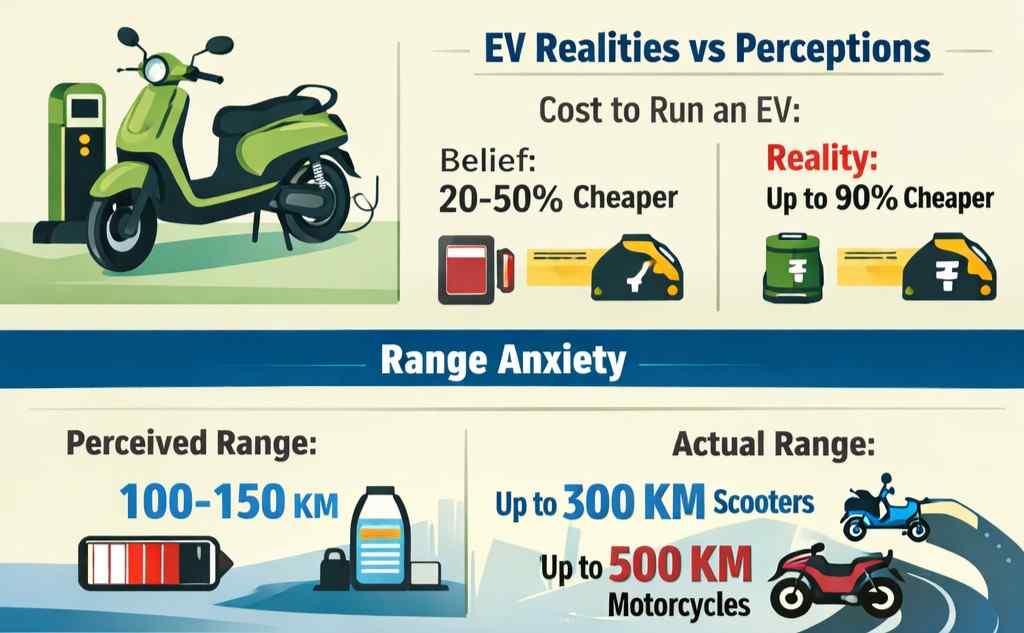
While pure-play EV manufacturers enjoy strong brand recall, the study reveals a significant gap between perception and reality when it comes to the benefits of EV ownership. A majority of respondents believe electric two-wheelers are only 20–50% cheaper to run than petrol-powered vehicles. In contrast, real-world usage data indicates that running costs can be up to 90% lower, depending on battery cell technology and usage patterns. This underestimation materially distorts the perceived value proposition of EVs, particularly for daily commuters for whom fuel and maintenance form a substantial portion of lifetime vehicle costs.
The research suggests that the economic narrative around EVs has failed to fully penetrate consumer decision-making. Rather than being seen as a fundamentally different and superior mobility solution, EVs continue to be viewed as marginally cheaper substitutes for internal combustion engine (ICE) vehicles, limiting their appeal beyond early adopters.
Range Anxiety Persists Despite Technological Progress
Contrary to the assumption that high upfront cost is the dominant adoption barrier, the study identifies range anxiety and long-term confidence as the primary concerns among consumers. Most respondents estimate EV range to be between 100 and 150 km on a single charge – figures that are increasingly outdated. Several electric scooters in the market now offer ranges of up to 300 km, while electric motorcycles can deliver up to 500 km under certain conditions.
This disconnect underscores a broader issue: awareness of technological advancements in battery efficiency, thermal management and power electronics remains limited, even as the products themselves have evolved rapidly. Importantly, the belief gap is not confined to casual observers or first-time evaluators. Even consumers actively considering an EV continue to underestimate both range and cost savings, indicating that misinformation persists deep into the purchase funnel.
A Category-Building Challenge, Not Just a Marketing One
The findings point to a structural challenge in the evolution of India’s EV ecosystem. The category has grown rapidly in volumes and visibility, but not in consumer understanding. EVs are still perceived as carrying risks around longevity, reliability and real-world usability – perceptions that persist despite growing evidence to the contrary.
This misalignment has broader implications. Large-scale EV adoption is not only an economic or technological shift, but also a public health and quality-of-life imperative. Improvements in air quality, particularly in urban centres grappling with hazardous AQI levels, are achievable only through meaningful electrification of mobility at scale. Yet, the environmental and societal benefits of EV adoption remain under-communicated in consumer narratives.
Educating The Market
To bridge these gaps, the study highlights the need for EV manufacturers to intensify category-building efforts across all consumer touchpoints. This includes clearer communication in advertising, more experiential education at retail outlets, and consistent reinforcement of performance, reliability and cost benefits during ownership and service interactions.
As India pushes towards its electrification goals, the challenge may no longer be about building better EVs, but about ensuring that consumers understand just how transformative those vehicles already are. Until perception catches up with reality, adoption is likely to trail the true potential of electric mobility in the country.