


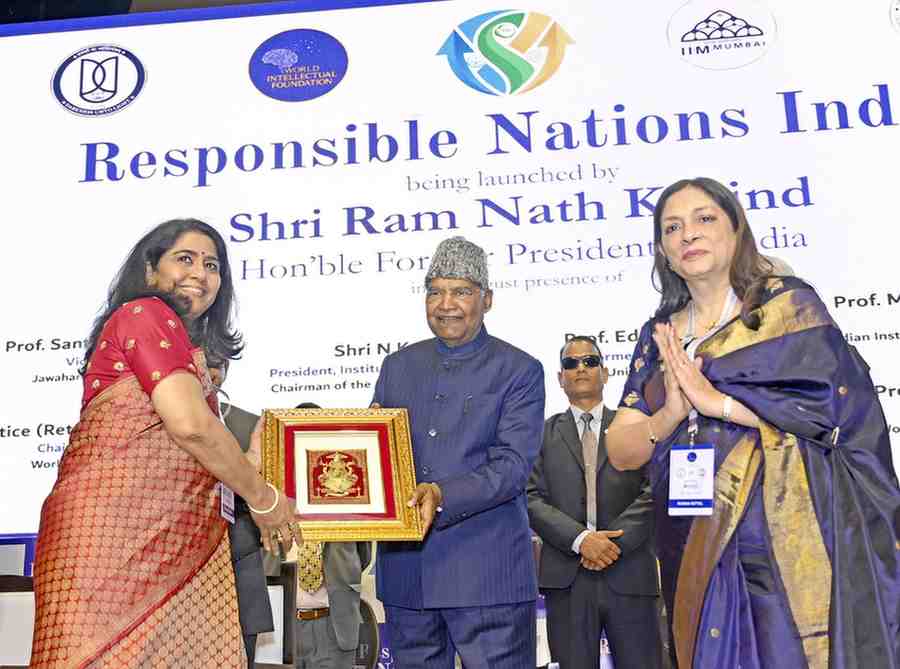
India’s launch of the Responsible Nations Index (RNI) under the aegis of the World Intellectual Foundation (WIF) marks a quiet but consequential shift in how national power and global leadership are defined. At a time when traditional indices overwhelmingly privilege economic output, military capability, or financial depth, the RNI introduces a broader, values-driven framework – one that places ethical governance, social well-being, environmental stewardship, and global responsibility at the heart of national assessment.
Developed through a three-year academic and policy research initiative, with scholarly contributions from Jawaharlal Nehru University (JNU) and Indian Institute of Management Mumbai, the RNI is an attempt to recalibrate global benchmarks to better reflect the realities and expectations of the 21st century.
Why the World Needs a Responsible Nations Index
Most global rankings today – GDP tables, ease-of-doing-business scores, military power indices – measure capacity, not conduct. They quantify what nations possess, not how they govern, include, or sustain.
The RNI addresses this blind spot. By incorporating parameters such as ethical and transparent governance, social inclusion and human well-being, environmental responsibility and sustainability and constructive global engagement and multilateral responsibility. The Index reframes national strength as the ability to balance growth with fairness, power with accountability and ambition with stewardship.
In an era defined by climate crises, widening inequality, geopolitical fragmentation, and trust deficits in institutions, this shift is not merely academic. It aligns global measurement systems with the lived challenges facing governments and societies.
A Norm-Setting Moment for Global Governance
One of the RNI’s most significant contributions is its norm-setting potential. Indices shape behaviour. Just as economic rankings have driven policy reforms over decades, a responsibility-focused index can incentivise nations to improve governance standards, invest in social infrastructure, strengthen environmental commitments and engage more constructively in global problem-solving.
Importantly, the RNI does not reject economic or strategic power—but contextualises it within ethical and social outcomes. This makes it especially relevant for emerging economies and middle powers that may not dominate traditional power metrics but play critical roles in global stability.
India’s Strategic Positioning
India’s role in launching and intellectually anchoring the RNI is itself significant. As a nation navigating the dual imperatives of rapid economic growth and social and environmental responsibility, India occupies a unique position in the global order. It represents a large democracy with complex governance challenges, a global South leader advocating inclusive development and a country balancing national interest with multilateral engagement.
By championing the RNI, India signals its intent to shape global discourse not merely participate in it. This aligns with India’s broader diplomatic narrative around Vasudhaiva Kutumbakam (the world as one family), climate leadership, digital public infrastructure and development partnerships.
The involvement of institutions like JNU and IIM Mumbai further grounds the Index in academic rigour and policy relevance, reinforcing India’s growing role as a knowledge producer rather than a passive consumer of Western-designed frameworks.
Soft Power, Not Symbolism
Crucially, the RNI is not symbolic positioning- it is soft power through standards. Nations that define metrics influence how success is judged. By moving the conversation beyond economic supremacy to responsible leadership, India is effectively broadening the global definition of what it means to be a leading nation.
For developing economies, the RNI offers a fairer comparative lens—one that recognises social progress, governance reform and sustainability efforts that often go unnoticed in conventional rankings.
For advanced economies, it introduces accountability beyond wealth accumulation, questioning whether prosperity is being delivered responsibly and inclusively.
The true impact of the Responsible Nations Index will depend on its adoption, transparency, and evolution over time. But its launch already represents a meaningful intervention in global thought leadership.
At a moment when the international system is searching for legitimacy, trust, and direction, the RNI suggests a simple but powerful idea: national greatness is not just about power- it is about responsibility. In placing this idea at the centre of global measurement, India has not only launched an index- it has initiated a conversation the world increasingly needs to have.