


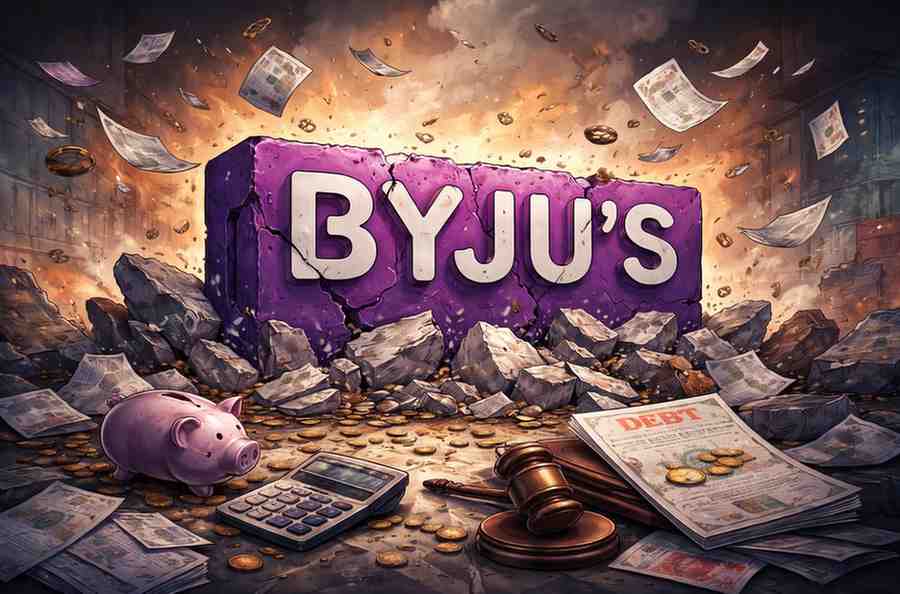
Once the crown jewel of India’s edtech boom, Byju’s today stands as one of the most dramatic corporate unravellings in the country’s startup history. A company that commanded a peak valuation of over $20 billion is now battling cash crunches, creditor lawsuits, investor revolts, and court-mandated scrutiny across multiple jurisdictions. What began as a growth-at-any-cost expansion has spiralled into a complex financial and governance crisis – raising uncomfortable questions about capital discipline, founder control and the risks embedded in India’s venture-funded edtech model.
Byju’s has been caught in a tug-of-war with major investors over governance issues, rights to funds, and strategic control. A recent example shows key investors successfully pressuring courts to lock the money raised in a rights issue into a separate escrow account- a move that has halted salary payments to employees and escalated tensions between the management and dissenting investors.
The core of the dispute is allegations by a group of investors- including Prosus, Peak XV Partners, and others – of mismanagement and fund misalignment, prompting legal action and demands to overhaul leadership.
Across the globe, Byju’s has faced severe scrutiny in the US courts, where lenders have alleged misdirection of loan funds. A notable court decision — involving claims of unauthorized transfers of $533 million – has intensified scrutiny on the company’s financial conduct, adding international legal pressure on the founder and executives.
For its part, the company has fought back, with leadership levelling allegations of collusion between creditor representatives, auditors, and resolution professionals in public posts disputing their conduct and motivations.
Domestically, Byju’s faced insolvency proceedings over unpaid dues to India’s cricket board (BCCI) – a landmark case as this paired a corporate debt default with India’s largest sports body. The National Company Law Tribunal (NCLT) even appointed resolution professionals to oversee operations in the earlier stages of proceedings, reflecting the seriousness of its cash-flow crisis.
Once a flagship unicorn, Byju’s valuation has been dramatically marked down by investors- in some estimates down to near zero – reflecting waning confidence and fundraising challenges. One major backer, Prosus, has even written off its investment entirely, incurring losses of hundreds of millions of dollars.
With funds from a $200 million rights issue frozen, the company has been unable to process employee salaries, intensifying internal morale and public scrutiny.
Facing mounting liabilities, Byju’s has been forced to offload assets abroad -including the US businesses acquired in earlier expansion phases- often at distress sale valuations far below purchase prices. This underlines both the depth of the cash crisis and strategic retrenchment.
Beyond financial metrics, observers – including government probes – have flagged corporate governance shortcomings. Indian authorities found lapses like delayed disclosures, rushed board approvals, and compliance weaknesses, though they did not conclusively identify fraud within the scope of that probe.
These governance issues fuel investor mistrust and have been central to the conflicts over board control and executive removal. In response, Byju’s CEO has both defended strategic decisions and publicly criticized external parties’ influence on company affairs.
Byju’s collapse is more than just a company downturn – it signals structural challenges in the edtech sector. Over-reliance on capital raises rather than sustainable revenue generation. Aggressive acquisitions that strained balance sheets. Investor expectations of unbounded growth, leading to governance and strategic mismatches. The saga is prompting investors to rethink due diligence and value metrics in edtech, potentially tightening future funding for similar startups.
The future hinges on resolution of legal cases, restructuring outcomes, and investor-founder realignment. There have been indications of acquisition interest from education conglomerates aiming to absorb parts of Byju’s in an insolvency framework, suggesting a possible break-up or reignition under new leadership.
Cross-border lawsuits and counterclaims can stretch for years, meaning uncertainty may persist. Current web chatter even suggests a dynamic legal conflict with recent counterclaims filed in the US courts.
Founder Byju Raveendran has publicly expressed intent to revive the company’s core education mission, but repaying debts, rebuilding trust, and stabilizing operations remain huge hurdles. Byju’s stands at a crossroads: from one of India’s most aspirational tech success stories to a cautionary tale of rapid scaling, governance lapses, investor conflict, and financial stress. Its current plight – defined by legal entanglements, valuation erosion, and operational strain -is reshaping not just the company’s future, but investor expectations across the Indian startup ecosystem.