


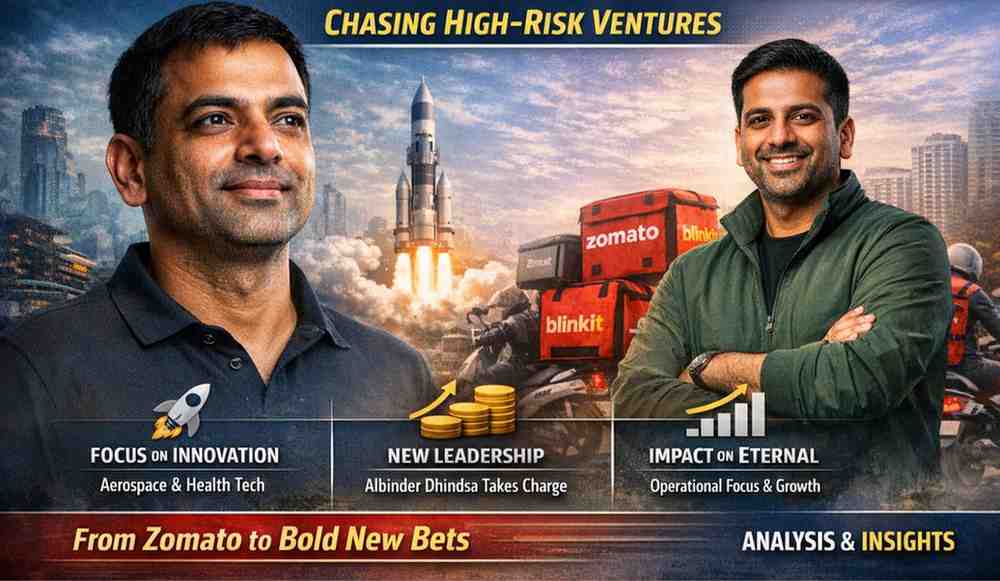
In a decisive shift in leadership philosophy at one of India’s most closely watched consumer internet companies, Zomato founder Deepinder Goyal has stepped away from the CEO role at Eternal, the parent entity housing Zomato, Blinkit and other digital businesses. Goyal’s stated reason- to focus on high-risk projects –marks a rare and deliberate break from the operational demands of a publicly listed company, raising important questions about governance, growth strategy and the future trajectory of Eternal Group.
The transition places Blinkit CEO Albinder Dhindsa at the helm of Eternal, underlining a broader move from founder-led vision to execution-driven leadership at a time when profitability, scale and predictability have become paramount for Indian tech firms.
From Founder-Operator to Strategic Architect
Deepinder Goyal’s exit from day-to-day leadership does not represent a withdrawal from Eternal altogether. He remains Vice Chairman of the Board, retaining influence over long-term strategy and governance. However, stepping away from the CEO role is significant, especially given Goyal’s central role in building Zomato from a restaurant discovery platform into a diversified consumer internet company spanning food delivery, quick commerce and logistics.
Goyal has been candid about his motivations. According to internal and public communications, his appetite for high-risk, experimental ventures- often involving long gestation periods and uncertain commercial outcomes- is increasingly at odds with the expectations placed on the CEO of a listed entity. Public market scrutiny, regulatory obligations and shareholder risk tolerance impose constraints that can limit radical experimentation.
Why High-Risk Innovation Doesn’t Fit a Public Company CEO Role
Publicly listed companies like Eternal are designed to optimise execution, margin expansion and predictability. While innovation remains critical, it is typically incremental and aligned with core businesses. Goyal’s interest in frontier ideas – reportedly spanning areas beyond food and commerce – would require capital allocation and risk exposure that markets often penalise.
Albinder Dhindsa’s Appointment: A Signal of Operational Focus
The elevation of Albinder Dhindsa, CEO of Blinkit, to Group CEO is a deliberate and telling choice. Blinkit has emerged as Eternal’s fastest-growing and most operationally complex vertical, competing in India’s fiercely contested quick-commerce market.
Dhindsa’s leadership style contrasts with Goyal’s founder-driven experimentation. He has strong emphasis on unit economics and tight control over logistics and supply chains. His aggressive but disciplined expansion strategy is well known.
For investors, this signals a shift toward execution excellence, especially at a time when competition from Swiggy Instamart, Zepto and emerging players is intensifying.
Impact on Eternal Group’s Core Businesses
Zomato’s core food delivery platform has matured into a relatively stable business with predictable growth and improving margins. Under Dhindsa, the focus is likely to remain on improving restaurant partner economics, reducing delivery inefficiencies and enhancing customer retention rather than aggressive discounting. The absence of founder-led experimentation may actually strengthen operational discipline.
Blinkit and Quick Commerce
Blinkit is now central to Eternal’s growth narrative. Dhindsa’s elevation suggests continued prioritisation of quick commerce, greater capital and management attention. There is expected to be a push towards faster break-even and profitability. This could redefine Eternal from being Zomato-centric to a multi-vertical consumer logistics company.
Corporate Strategy and Capital Allocation
With Goyal no longer driving experimental initiatives within the group, Eternal’s capital deployment is expected to become more conservative, sharply aligned with existing verticals, less tolerant of unrelated diversification while this clarity is often welcomed by institutional investors.
Market and Investor Response
Initial market reactions have been measured to positive, suggesting that investors view the leadership transition as orderly rather than disruptive. The fact that Goyal remains involved at the board level and a proven internal leader has taken charge have been seen as positive.
For public markets, this move reduces key-man risk while strengthening governance maturity- a crucial factor as Indian tech companies move from founder-centric narratives to institutional credibility.
Cultural and Organisational Implications
Internally, Eternal may experience a cultural recalibration with less emphasis on visionary leaps and greater focus on metrics, performance and accountability. This will lead to clearer separation between experimentation and execution. While this may reduce the pace of disruptive innovation within the group, it could also create a more sustainable operating environment for employees and partners.
What’s Next for Deepinder Goyal?
Goyal’s decision to focus on high-risk projects places him back in the role of a serial entrepreneur, rather than a corporate steward. While details remain thin, such ventures typically involve deep tech or frontier innovation, long-term capital commitment and limited immediate commercial visibility. Importantly, Goyal’s continued presence on Eternal’s board allows for strategic cross-pollination, without exposing the company to undue risk.
The Bigger Picture: A Maturing Indian Tech Ecosystem
This transition reflects a broader evolution in India’s startup ecosystem wherein founders recognising the limits of founder-centric leadership at scale. Eternal’s leadership reset may well become a case study in how Indian tech companies navigate the shift from startup ambition to institutional maturity.