


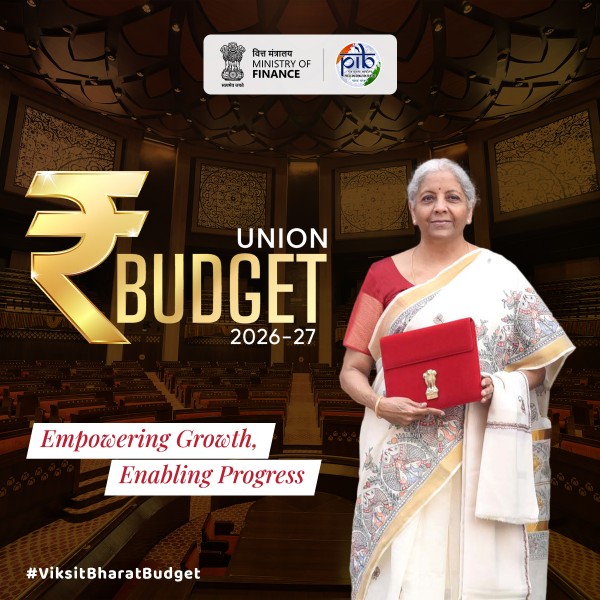
The Union Budget 2026-27 has laid out a calibrated overhaul of customs and central excise duties, signalling the government’s intent to simplify India’s tariff architecture while aligning it more closely with domestic manufacturing priorities, energy transition goals and export competitiveness.
Presenting the Budget in Parliament, Finance Minister Nirmala Sitharaman underlined that the proposals aim to rationalise long-standing duty exemptions, correct inverted duty structures and reduce classification disputes by embedding effective rates directly into the customs tariff schedule. This move is expected to improve transparency, reduce litigation and enhance ease of doing business for importers and manufacturers alike.
Tariff Rationalisation and Import Substitution
A key structural reform in the Budget is the withdrawal of customs duty exemptions on products that are already being manufactured domestically or where imports are insignificant. This signals a sharper focus on import substitution and protecting domestic value chains, while also pruning legacy exemptions that complicate the tariff regime.
By incorporating effective rates from multiple customs notifications into the tariff schedule itself, the government is also attempting to reduce compliance complexity and ambiguity around applicable duty rates.
Export Boost Through Targeted Duty-Free Imports
To strengthen export competitiveness, especially in labour-intensive sectors, the Budget proposes an increase in the duty-free import limit for specified inputs used in seafood processing, from 1% to 3% of the previous year’s FOB export turnover. This move is likely to ease cost pressures for exporters amid volatile global demand.
In a similar push, duty-free import benefits currently available to exporters of leather and synthetic footwear have been extended to shoe uppers, while the export timeline for leather, textile garments and footwear products has been extended from six months to one year. Together, these measures aim to improve working capital efficiency and reduce operational bottlenecks for exporters.
Energy Transition and Critical Sectors in Focus
Energy security and transition form a central pillar of the customs proposals. The extension of basic customs duty (BCD) exemptions on capital goods used in lithium-ion cell manufacturing to battery energy storage systems reflects India’s broader push towards clean energy infrastructure.
The solar sector also receives support, with BCD exemption on sodium antimonate imports for solar glass manufacturing—critical for strengthening domestic solar value chains. Additionally, the extension of BCD exemption for nuclear power project imports until 2035, across plants of all capacities, underscores the government’s long-term commitment to nuclear energy as part of India’s energy mix.
Further, exempting capital goods required for processing critical minerals positions India to reduce import dependence in strategic materials essential for energy, electronics and defence sectors.
Aviation, Defence and Electronics Manufacturing Get Tailwinds
The Budget provides targeted relief to the aviation and defence ecosystem by exempting customs duty on components and raw materials required for manufacturing and MRO (maintenance, repair and overhaul) of civilian, training and defence aircraft. This aligns with the ‘Make in India’ and ‘Atmanirbhar Bharat’ objectives in high-value manufacturing segments. In consumer electronics, duty exemption on specified parts used in microwave oven manufacturing is aimed at deepening local value addition and reducing reliance on imported finished goods.
SEZ Relief Amid Global Trade Disruptions
Acknowledging capacity underutilisation in Special Economic Zones (SEZs) due to global trade disruptions, the Budget introduces a one-time concessional duty window allowing eligible SEZ manufacturing units to sell into the Domestic Tariff Area (DTA). These sales will be capped at a prescribed proportion of exports, with regulatory safeguards to ensure a level playing field for domestic manufacturers.
Big Picture: Strategic, Not Populist
Overall, the customs and excise proposals in Budget 2026-27 reflect a strategic, sector-specific approach rather than broad-based duty cuts. The focus remains on simplifying the tariff structure, incentivising domestic manufacturing in sunrise and strategic sectors, supporting exports, and aligning fiscal policy with India’s long-term energy and industrial goals. As global supply chains remain volatile, the success of these measures will depend on timely regulatory implementation and the ability of domestic industry to scale up efficiently under the revised tariff framework.