


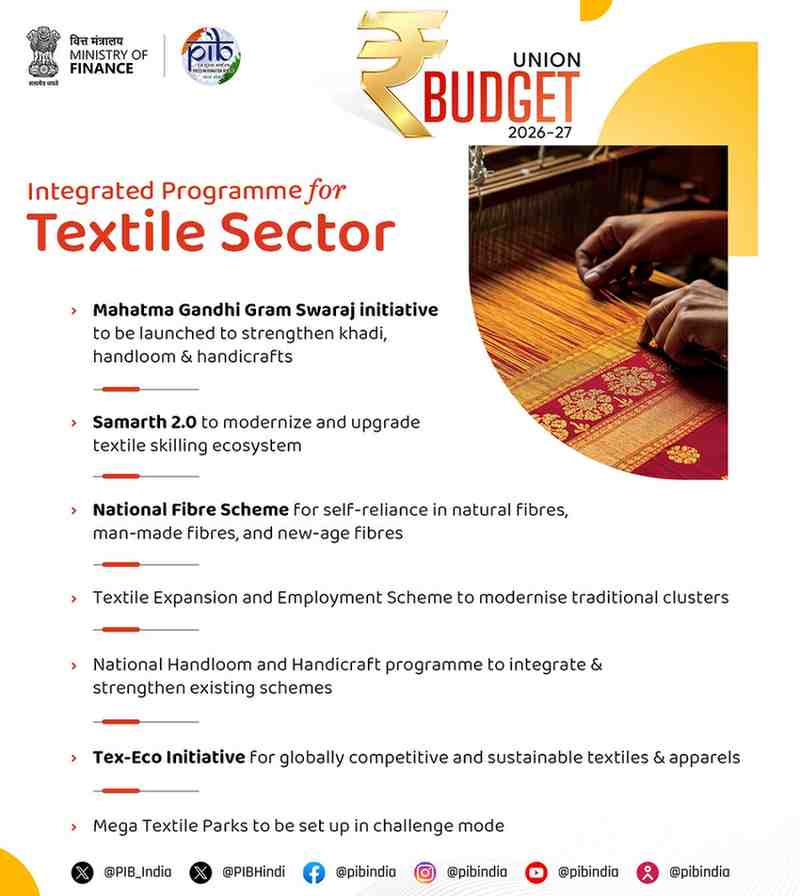
The Union Budget has positioned textiles at the centre of India’s employment and export strategy, rolling out a comprehensive policy framework aimed at strengthening the entire value chain, from fibre production and village industries to large-scale manufacturing and global markets. By focusing on labour-intensive segments alongside modern manufacturing and sustainability, the Budget signals a shift from fragmented scheme-based support to an integrated industrial strategy for one of India’s largest job-creating sectors.
Integrated Programme Signals End-to-End Policy Push
At the core of the textile announcements is a proposed Integrated Programme for the Textile Sector, designed to improve competitiveness, reduce import dependence and generate large-scale employment.
The National Fibre Scheme aims to make India self-reliant across natural, man-made and emerging fibre categories. By supporting silk, wool, jute, man-made fibres and new-age materials, the government is seeking to address a long-standing vulnerability in the textile value chain—dependence on imported fibres and raw materials—while encouraging innovation in advanced textiles.
Complementing this is the Textile Expansion and Employment Scheme, which targets productivity constraints in traditional clusters through capital support for machinery modernisation, technology upgrades and common testing and certification facilities. This is expected to help small and mid-sized units meet global quality standards while expanding employment at scale.
Handlooms, Crafts and Rural Livelihoods Brought into Mainstream
The integration of existing handloom and handicraft schemes under a National Handloom and Handicraft Programme reflects an attempt to improve targeting, reduce overlap and enhance income support for weavers and artisans. By aligning heritage sectors with organised value chains, the Budget seeks to balance cultural preservation with commercial viability.
The proposed Mahatma Gandhi Gram Swaraj Initiative further strengthens this rural focus, with emphasis on branding, skilling, quality improvement and global market access for khadi, handloom and village industries. Linked with the One District One Product (ODOP) framework, the initiative aims to convert local craftsmanship into scalable export opportunities.
Sustainability and Skills Take Centre Stage
With global buyers increasingly demanding environmentally responsible sourcing, the Tex-Eco Initiative aims to align India’s textile and apparel industry with international sustainability standards. The move positions sustainability not as a compliance burden, but as a competitive advantage in green and premium markets.
On the workforce side, Samarth 2.0 upgrades the textile skilling ecosystem through closer industry–academia collaboration. The focus is on producing industry-ready manpower across the value chain, addressing skill mismatches that have historically limited productivity gains in the sector.
Mega Textile Parks and Technical Textiles
The announcement of Mega Textile Parks in challenge mode signals a renewed push for scale, integrated infrastructure and value addition. These parks are expected to reduce logistics costs, improve cluster efficiencies and attract private investment. Importantly, the parks will also support growth in technical textiles, a high-value segment with applications in defence, healthcare, infrastructure and industry, helping diversify India’s textile basket beyond apparel and home furnishings.
Export Flexibility and MSME Liquidity Relief
In a significant export-friendly move, the Budget extends the export obligation period from six months to one year for textile and leather exporters using duty-free imported inputs. This is expected to ease working capital stress, improve compliance and provide operational flexibility amid volatile global demand.
For textile MSMEs, liquidity access has been strengthened through a comprehensive revamp of the Trade Receivables Discounting System (TReDS). Mandatory TReDS usage by CPSEs, credit guarantee support via CGTMSE, integration of GeM with TReDS and securitisation of TReDS receivables are expected to lower financing costs and unlock faster cash flows.
Creating Future Champions
To support scale-up and competitiveness, the Budget has announced a ₹10,000 crore SME Growth Fund aimed at creating “Champion SMEs”. The fund will incentivise high-potential enterprises based on select performance criteria, while also supporting micro enterprises across the textile ecosystem.
Taken together, the textile announcements in Budget 2026–27 reflect a strategic recalibration, from piecemeal interventions to an integrated, employment-led industrial policy. By combining fibre security, manufacturing scale, rural inclusion, sustainability and export facilitation, the government is attempting to position India as a global textile manufacturing hub at a time when supply chains are diversifying away from single-country dependence.
The success of this ambitious agenda, however, will hinge on execution, particularly coordination with states, timely infrastructure rollout and effective industry participation. If implemented well, the textile push could emerge as one of the most consequential employment and export drivers of the decade.