


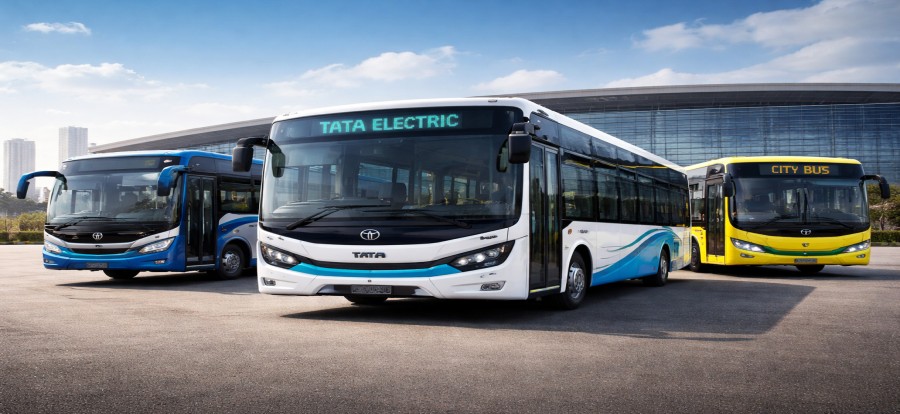
Tata Motors Ltd is adopting a calibrated and financially disciplined approach to growth in its commercial vehicle (CV) business, balancing selective participation in government tenders with strong international expansion and a renewed domestic demand outlook, Managing Director and CEO Girish Wagh said during the company’s earnings call.
In the domestic bus segment, Tata Motors has moved away from aggressive, volume-driven bidding and is instead focusing on risk-managed participation in tenders, based on operational learnings from running buses across multiple cities.
The company is evaluating bus tenders on three key parameters: payment security mechanisms, asset-light operating models, and financial prudence. In recent large tenders, including the 10,000-bus programme, Tata Motors participated largely through consortium structures, where experienced bus operators acted as the front-facing partners, limiting balance-sheet exposure. In select Smart City tenders, the company also bid directly. This strategy reflects Tata Motors’ intent to grow profitably in the electric and conventional bus space without taking undue execution or payment risks.
Tata Motors’ international commercial vehicle business has delivered a strong performance, with shipments rising 70% year-on-year during the current fiscal. Growth has been led by the SAARC region, with Sri Lanka staging a meaningful recovery, alongside solid traction in the Middle East and North Africa (MENA) region. New market entries in North Africa have scaled up well, while Sub-Saharan Africa continues to contribute steadily.
Management indicated that the international business has become a structurally stronger pillar, supporting overall CV growth and reducing dependence on domestic cyclicality.
Looking ahead, Tata Motors expects the positive momentum seen in Q3 to continue into Q4, supported by improved consumption trends following GST-related stabilisation and increased government-led infrastructure activity.
Demand is expected to improve across trucks, buses, vans and small commercial vehicles, with buses typically seeing stronger ordering and deliveries in Q4 and Q1 due to their cyclical nature. In the truck segment, the sharp recovery witnessed in Q3 is expected to sustain, aided by the launch of 17 new truck models, which expand Tata Motors’ footprint across key logistics and transportation categories.
Across segments, Tata Motors is focusing on volume growth and portfolio expansion. Trucks: New launches aimed at accelerating market share gains across payload and application categories. Buses and Vans: Deliveries set to begin against strong government tender wins secured over the past two quarters.
Small Commercial Vehicles: Clear volume ramp-up strategy for Ace Pro, Ace and Intra platforms. Parts & Services: Continued growth supporting margins and customer stickiness. Management emphasised that the company is focused on consistent delivery across key financial and operating metrics, rather than chasing isolated performance indicators.
Tata Motors’ market share recovery in Q3 was driven primarily by heavy commercial vehicles, particularly in the tipper segment, where the company already enjoys a strong position. Higher infrastructure-led demand and revenue salience in tippers helped Tata Motors further strengthen its share.
Targeted actions in specific micro-markets during the quarter also supported market share gains. Looking ahead, management believes the recent product launches address nearly all critical logistics and transportation requirements, positioning the company for continued share improvement.
Tata Motors’ CV strategy is increasingly defined by selective risk-taking, international diversification and product-led growth. With international markets scaling up, domestic demand recovering and a refreshed product portfolio coming on stream, the company appears well placed to sustain momentum while maintaining financial discipline in a cyclical industry.