


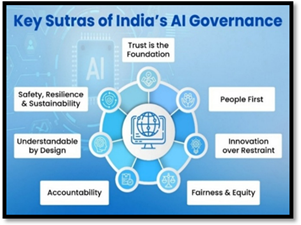
India has taken a bold step towards shaping the future of artificial intelligence with the adoption of a principle-based AI governance framework anchored in seven core principles or sutras. The framework, released at a time when AI is rapidly becoming central to economic competitiveness and state capacity, positions India as a jurisdiction that seeks to enable innovation rather than constrain it, while embedding trust, accountability and inclusion at the heart of technological progress.
The framework reflects India’s view of Artificial Intelligence as the defining force of the Fifth Industrial Revolution. Rather than treating AI purely as a regulatory challenge, policymakers are framing it as a national growth catalyst, one that can drive productivity across agriculture, healthcare, education, manufacturing, governance and climate action. This approach is explicitly aligned with the long-term national vision of Viksit Bharat 2047, positioning AI as both an economic multiplier and an instrument of social empowerment.
The AI governance framework is anchored in seven guiding principles: trust as the foundation, people-first design, innovation over restraint, fairness and equity, accountability, understandability by design, and safety, resilience and sustainability. Together, these sutras establish a coherent, cross-sectoral and technology-neutral governance philosophy. Instead of prescribing rigid rules for a fast-evolving technology, the framework adopts a flexible, principle-driven approach that can adapt to new use cases and innovations over time.
This design choice is particularly significant for India’s startup and innovation ecosystem. By prioritising innovation over restraint, the framework avoids the regulatory overhang that has slowed AI experimentation in some global markets. For startups, researchers and enterprises, this translates into regulatory clarity without excessive compliance friction, an important advantage in a domain where speed and iteration matter.
To operationalise this philosophy, the guidelines recommend the creation of new national institutions, including an AI Governance Group, a Technology & Policy Expert Committee, and an AI Safety Institute. These bodies are intended to anchor a whole-of-government approach, balancing innovation with risk mitigation while ensuring coordination across ministries and regulators.
The framework has been developed under the leadership of the Ministry of Electronics and Information Technology, which constituted a drafting committee in July 2025. The committee drew on existing laws, global best practices, academic literature and public consultations, resulting in a four-part framework that spans guiding principles, issue analysis, an action plan, and practical implementation guidelines for industry and regulators.
Importantly, India’s governance push is underpinned by tangible progress on AI infrastructure and adoption. Under the IndiaAI Mission, more than 38,000 GPUs have been onboarded through a subsidised national compute facility, while AIKosh now hosts over 9,500 datasets and 273 sectoral AI models. The National Supercomputing Mission has operationalised over 40 petaflop-scale systems, including AIRAWAT and PARAM Siddhi-AI, strengthening sovereign compute capabilities.
Capacity-building remains a parallel focus. IndiaAI and FutureSkills initiatives are supporting hundreds of PhDs and thousands of students, while a growing network of AI Data Labs and IndiaAI labs is pushing AI adoption beyond major metros. With nearly 90% of startups already integrating AI in some form, the ecosystem is firmly in a deployment-first phase.