


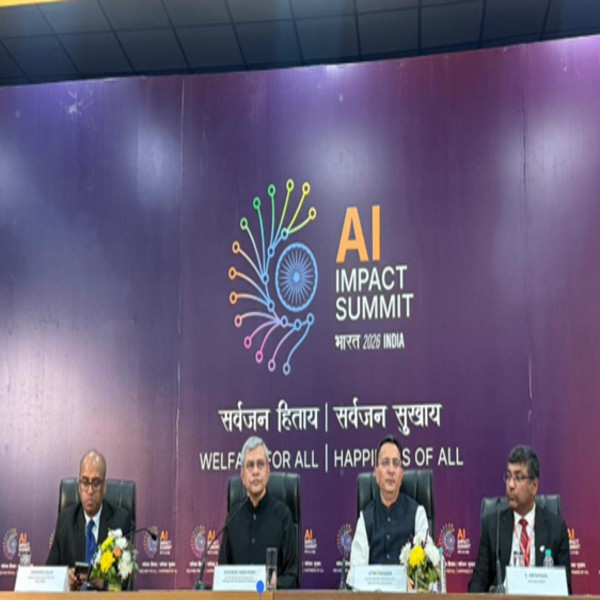
India will significantly expand its national artificial intelligence computing capacity with the addition of 20,000 GPUs in the coming weeks, taking the country beyond its existing base of 38,000 GPUs, Union Minister for Electronics and Information Technology Ashwini Vaishnaw announced on the second day of the India AI Impact Summit 2026.
Addressing the media at the summit, the minister said the expansion marks the next phase of India’s AI strategy, combining large-scale compute augmentation with a strong emphasis on responsible AI development and deployment. He underlined that the government’s focus remains on ensuring that AI applications deliver broad-based benefits, particularly in critical sectors such as healthcare and education.
Unlike several countries where AI infrastructure is concentrated among a few large corporations, India has enabled wider access to AI compute resources across academia, startups, and industry, he noted.
The summit, being held from February 16–20 in New Delhi, has brought together heads of state and government, ministers, global technology leaders, researchers, multilateral institutions, industry stakeholders, startups and students. Highlighting the scale of global participation, the minister said top executives are leading nearly 20 high-level sessions, underlining strong international engagement. He acknowledged the efforts of the organising team, describing the event as the world’s largest AI summit.
On the investment outlook, Vaishnaw expressed optimism, projecting that over $200 billion in investments could flow into the AI ecosystem over the next two years. He said venture capital firms are increasingly committing capital to deep-tech startups, with investments spanning all five layers of the AI stack, including large-scale solutions and mission-critical applications.
The minister reiterated that the IT industry remains one of India’s core strengths and that managing technology transitions requires coordinated efforts between industry, academia and government. He said work is progressing simultaneously on three fronts: reskilling and upskilling the existing workforce, building a new talent pipeline, and preparing future generations for emerging technologies.
Referring to energy readiness, Vaishnaw noted that India is among a small group of countries where more than 50% of installed power generation capacity—currently about 51%—comes from clean sources, offering a strategic advantage for powering AI infrastructure. He added that the Future Skills programme, launched three years ago, is now being leveraged for AI-focused reskilling. The Ministry of Education and AICTE are also revising academic curricula to keep pace with technological change.
On sovereign AI capabilities, the minister said several Indian models launched at the summit have been benchmarked against global systems and have performed better than many large international models across multiple parameters. He added that Stanford University has ranked India among the top three AI nations globally, highlighting the country’s growing innovation capacity.
Acknowledging the risks associated with AI misuse, Vaishnaw stressed the need for a techno-legal framework that combines regulatory safeguards with technological solutions. India’s AI Safety Institute, a virtual body working with leading academic institutions, is developing tools to prevent misuse while enabling innovation, he said.
Describing AI as the driver of a “fifth industrial revolution,” the minister said its impact would span every sector of the economy. He pointed to AI-based healthcare and education solutions showcased at the summit that have the potential to reduce costs and enable personalised learning outcomes.
On semiconductor development, Vaishnaw reaffirmed the government’s commitment to the Semiconductor Mission, stating that design-led innovation will be the cornerstone of Semiconductor 2.0. He projected the emergence of at least 50 deep-tech startups in the coming years, driven by ongoing innovation efforts.