


India’s largest passenger vehicle maker Maruti Suzuki has commenced deliveries of its electric SUV, the eVitara, marking a significant step in the company’s long-term electric mobility strategy. The launch signals Maruti Suzuki’s intent to scale EV adoption through flexible ownership models, extensive service readiness and a charging ecosystem aligned with its mass-market footprint.
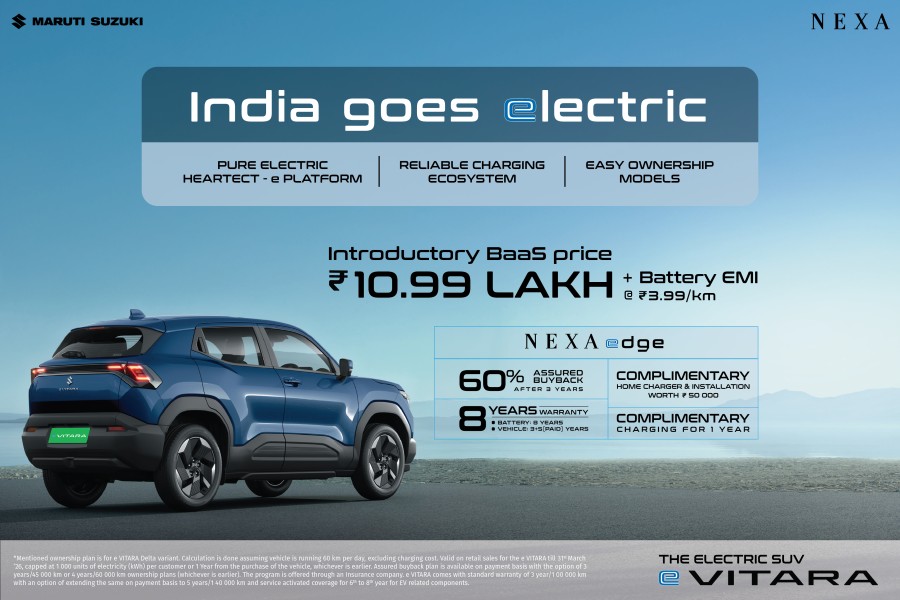
A key differentiator in Maruti Suzuki’s EV play is the introduction of Battery-as-a-Service (BaaS), under which the eVitara is priced at ₹10.99 lakh, with battery usage charged separately at ₹3.99 per kilometre. By decoupling battery ownership from vehicle purchase, the company aims to lower upfront acquisition costs and address customer concerns around battery life and replacement.
Speaking on the rollout, Partho Banerjee, Senior Executive Officer, Marketing and Sales, said the company’s EV strategy has been designed to position the eVitara as a primary choice for electric vehicle buyers. He said the model is supported by a comprehensive charging and service ecosystem, built to replicate the reliability that has defined Maruti Suzuki’s internal combustion portfolio over decades.
To support EV adoption at scale, Maruti Suzuki has readied over 1,500 EV-enabled service centres across the country, along with specially trained relationship managers at its NEXA outlets and dedicated charging managers. The company has also rolled out its ‘e for me’ digital platform, integrating charging discovery, scheduling and payments across one of India’s largest fast-charging networks.
From a financial and customer retention perspective, the automaker is offering assured buyback programmes of up to 60% value after three years, alongside flexible schemes such as ‘e Flex’, which allows customers to switch to the eVitara at EMIs comparable to their existing vehicles. These measures are aimed at reducing perceived risk and improving total cost-of-ownership visibility for first-time EV buyers.
The eVitara is available with 49 kWh and 61 kWh battery options, backed by an eight-year or 1.6 lakh km battery warranty, reinforcing the company’s focus on long-term ownership confidence. Maruti Suzuki is also offering early-adopter benefits, including complimentary home charging solutions and limited-period public charging incentives, valid until March 31, 2026.
Industry observers see Maruti Suzuki’s EV foray as a cautious yet scalable approach, leveraging its strengths in cost engineering, dealer reach and after-sales support rather than competing solely on technology differentiation. With the e Vitara, the company appears to be positioning electric mobility not as a niche premium offering, but as a mainstream transition aligned with its volume-led growth model.