


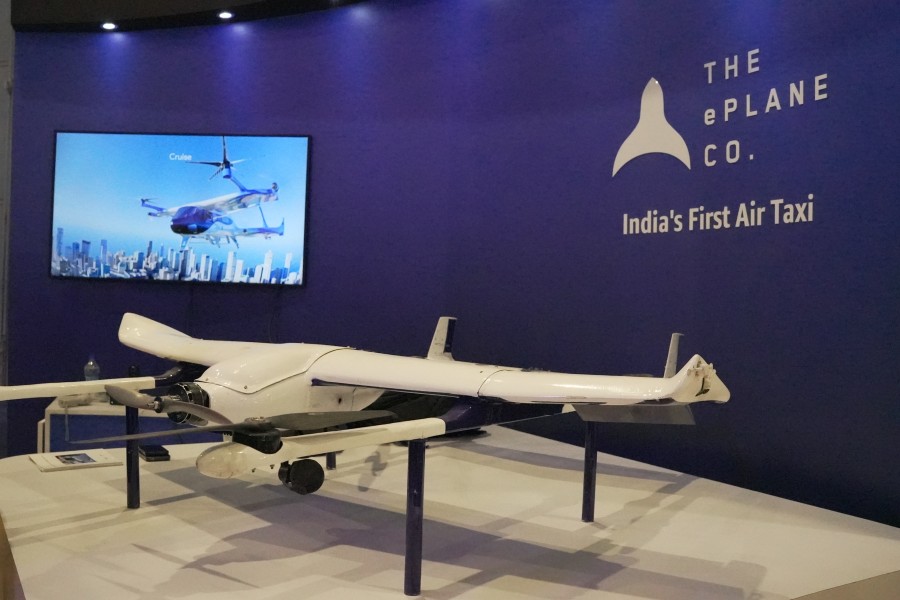
In a significant step for India’s emerging urban air mobility ecosystem, The ePlane Company has announced that it is building what it claims to be India’s first electric air taxi using advanced simulation technologies powered by Nvidia’s Omniverse libraries.
Incubated at Indian Institute of Technology Madras, The ePlane Company is developing the compact e200x electric vertical takeoff and landing (eVTOL) aircraft, aimed at easing urban congestion through sustainable aerial mobility. As part of its latest collaboration, the company will create a high-fidelity digital twin of the e200x using Nvidia Omniverse, setting a new benchmark for aerospace-grade simulation in India.
The digital twin will replicate the aircraft in a physics-accurate virtual environment, enabling engineers to simulate complex aerodynamic interactions, sensor responses, and flight scenarios with unprecedented precision. By leveraging Nvidia IGX as the onboard computing platform, the e200x will integrate multiple sensors , including cameras and radars , to support advanced data fusion, decision-making algorithms, and real-time visualisation.
Urban air mobility presents unique operational challenges, particularly around enhanced situational awareness and safety. Through simulation in Omniverse, The ePlane Company aims to validate millions of kilometres of virtual flight, stress-testing edge cases such as extreme weather, sensor failures, and collision scenarios , processes that would otherwise be costly and risky in physical trials.
The company also plans to tap into Nvidia Cosmos and the Nvidia Nemotron family of open-weight AI models to further strengthen its development and validation capabilities.
“We are not just building an aircraft; we are building an ecosystem,” said Satya Chakravarthy, Founder and CTO of The ePlane Company. “By validating our flight operations suite in Nvidia Omniverse, we are pushing the aircraft to its limits thousands of times in simulation so that we never have to in reality. This level of rigor defines sovereign aerospace capability.”
Beyond aircraft development, the collaboration also signals a new frontier for India’s deep-tech aviation sector. The computational intensity of these simulations requires high-performance computing infrastructure powered by top-tier GPUs, reinforcing India’s growing AI and advanced manufacturing capabilities. The high-fidelity digital twin will also function as a predictive analytics engine, mirroring real aircraft configurations to anticipate maintenance needs well before potential failures.
Tobias Halloran, Director of EMEAI Startups and Venture Capital at Nvidia, said India’s AI startup ecosystem is poised for rapid acceleration, supported by strong technical talent and global ambition. He noted that Nvidia is enabling this growth by providing startups access to accelerated computing, scalable AI infrastructure, and global support programmes.
The ePlane Company holds India’s first Design Organisation Approval (DOA) for a private electric aircraft and recently operationalised a 60,000 sq. ft. manufacturing facility in Chennai. With the e200x, it aims to position India at the forefront of next-generation electric aviation while addressing the pressing challenge of urban congestion