


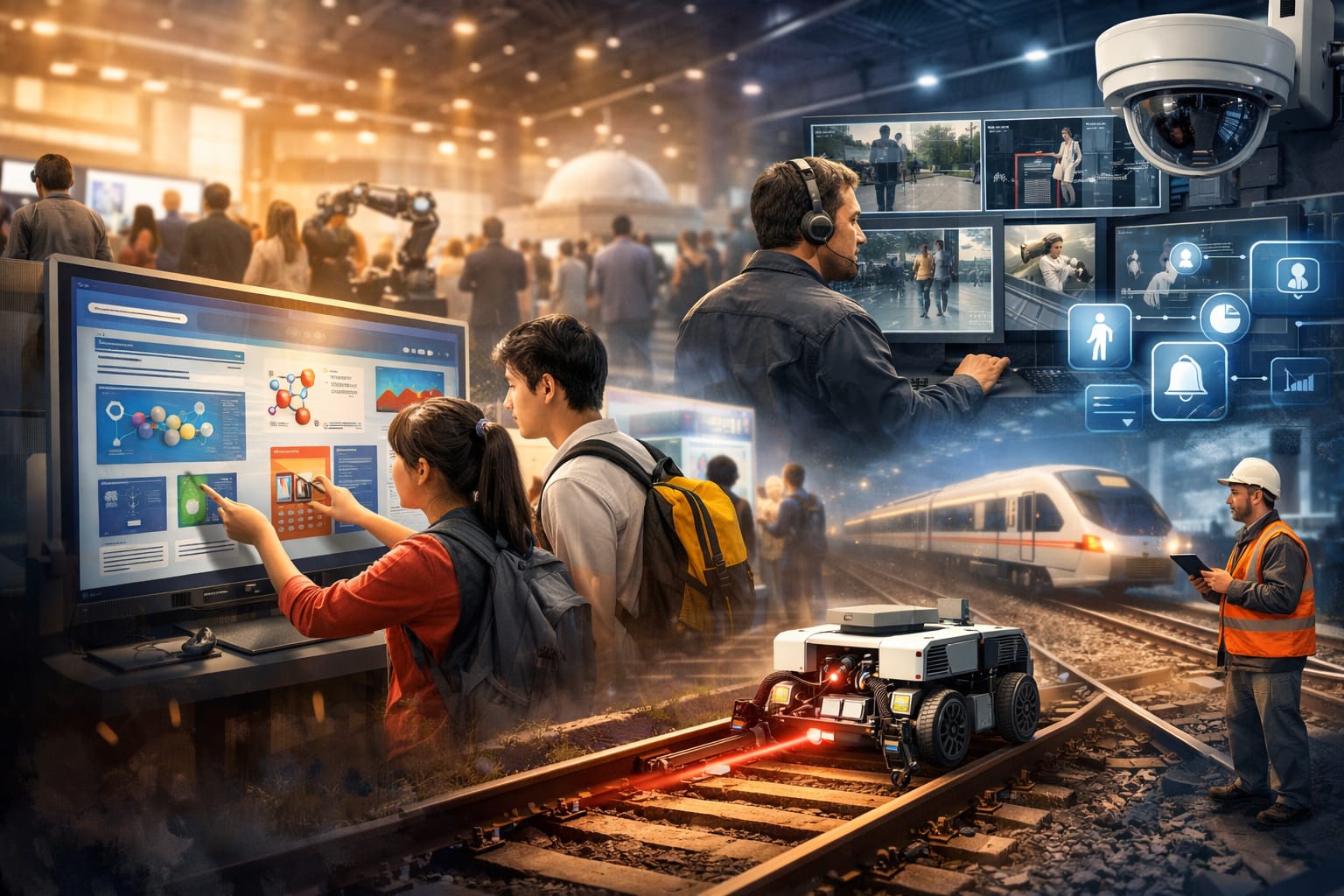
The energy inside the exhibition hall was unmistakable. Clusters of students leaned toward glowing screens, policymakers paused mid-conversation to watch live demos, and founders toggled between code and conversation. What unfolded over the course of the day was not a theoretical debate about Artificial Intelligence, it was a showcase of AI in action.
The AI Summit evolved into more than a conference. It became a solutions-driven forum where startups, researchers, industry leaders and government institutions demonstrated how emerging technologies are being translated into practical, everyday applications. Across sectors, education, infrastructure, surveillance and transport, one message resonated clearly: AI is no longer confined to prototypes; it is quietly embedding itself into public systems.
Reimagining Exam Preparation with IIT Kanpur
Near the entrance, a group of students gathered around a digital dashboard displaying SATHEE (Self Assessment, Test and Help for Entrance Exams), an initiative of the Ministry of Education and IIT Kanpur.
Launched in 2023, SATHEE offers free AI-powered preparation support for eight competitive examinations, including engineering, medical, law and public service entrance tests. But beyond content delivery, its focus is personalisation.
“We realised students don’t always study during fixed hours,” explained Dhruv Garg, software engineer at IIT Kanpur. “So we integrated AI features such as memory aids, visual problem solvers and automated summaries that allow students to study anytime, anywhere.”
The platform generates personalised study plans based on available hours, extracts formulas from lecture transcripts, identifies recurring conceptual confusion and even resolves doubts using AI tools. Available in 13 Indian languages, the initiative is designed to bridge the access gap for students who may not afford private coaching.
Early implementation in select government schools has shown promising results, with significant increases in qualifiers for competitive exams. For policymakers at the summit, it represented a compelling case of AI strengthening public education delivery.
Smart Surveillance, Smarter Response
A short walk away, attention shifted from textbooks to technology-enabled surveillance.
At the stall of Gurugram-based iiris: Value Catalysts, discussions centred on how AI is transforming traditional monitoring systems. Manager Zia Ahmad described how manual footage review — once time-consuming and resource-heavy — has given way to intelligent filtering.
“With AI-enabled tools, a single command can retrieve relevant footage based on clothing colour, time span or movement pattern,” he explained. Integrated systems linking cameras and motion sensors now generate real-time alerts, significantly improving response efficiency.
The firm is currently conducting security risk assessments for large infrastructure projects, including the Vrindavan Chandrodaya Mandir in Mathura. The emphasis, Ahmad noted, remains on structured risk mitigation, with AI acting as an enabler rather than a replacement for professional oversight.
Watching the Tracks Before They Fail
Perhaps the most striking demonstration came from RailLabs, where co-founder Sumit Anand showcased Arista, an autonomous AI-driven railway track inspection robot.
Using ultrasonic flaw detection, laser profiling and AI vision systems, Arista identifies surface and internal cracks, missing bolts and structural defects. “Even a crack above two millimetres can be dangerous,” Anand said, underscoring the importance of early detection. The system increases inspection efficiency by up to 200% compared to manual methods.
RailLabs’ wheel-shelling prediction system, ChakrVue, is already operational in select LHB and Tejas coaches across multiple cities, forecasting potential wheel failures before they occur and strengthening preventive safety measures.
A Summit Grounded in Practicality
As the day progressed, demonstration units hummed steadily and conversations deepened. What distinguished this summit was its practical orientation. Ideas were not merely presented, they were tested, questioned and refined with real-world application in mind.
From exam preparation dashboards to AI-enabled security systems and autonomous railway inspections, the exhibits reflected a broader national push to translate AI research into deployable public solutions.
In the animated exchanges between students, engineers and administrators, a clear shift was visible: Artificial Intelligence is no longer an abstract promise. It is becoming part of the infrastructure that quietly supports classrooms, protects assets and safeguards railway tracks, one practical solution at a time