


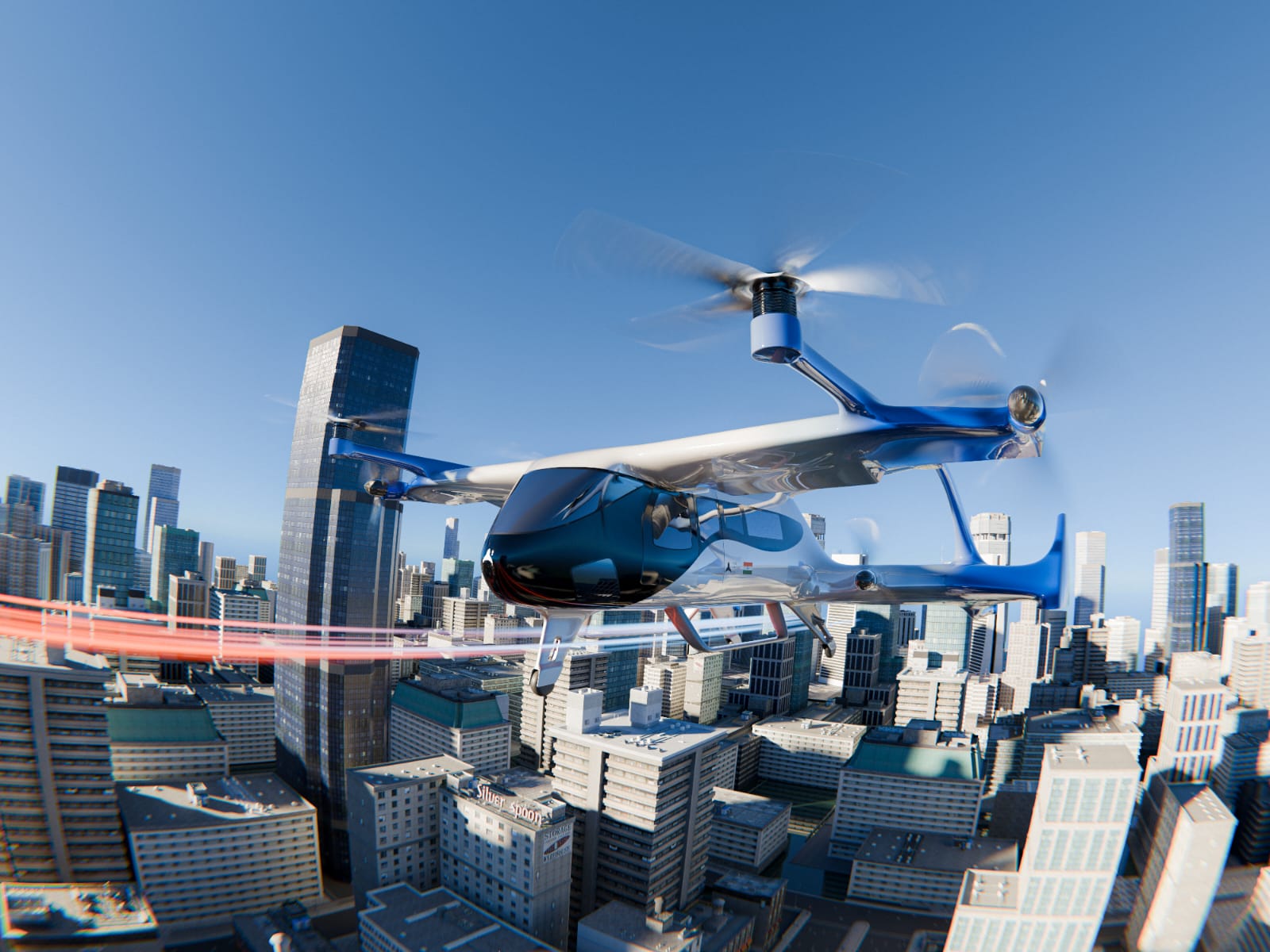
India’s urban air mobility ambitions moved a step closer to reality as The ePlane Company unveiled the country’s largest integrated eVTOL prototyping and testing facility at the IIT Madras Discovery Campus.
Spanning 60,000 sq. ft. at the Thaiyur campus, the facility marks a major transition from lab-scale prototypes to certification-grade, full-scale aircraft development. The site was inaugurated by IIT Madras director Professor V Kamakoti, whose vision for the 163-acre Discovery Campus has positioned it as a deep-tech manufacturing and research hub.
From Concept to Certification
The integrated facility will anchor the development of the company’s flagship e200X air taxi as it progresses into the full scale ground test vehicle (GTV) phase. It consolidates design, composite fabrication, electric powertrain assembly, avionics testing and subsystem validation under one roof, a move aimed at accelerating the path to type certification.
Crucially, the company is working closely with the Directorate General of Civil Aviation (DGCA) to help shape India’s certification and flight-testing framework for electric vertical take-off and landing (eVTOL) aircraft. Post initial design approvals, the collaboration focuses on establishing regulatory benchmarks for safe commercial operations in India.
Engineering for Dense Urban Environments
At the heart of the development programme is the e200X, described as the world’s most compact air taxi. With a patented 8m x 10m footprint and proprietary “Synergistic Lift” technology, the aircraft is designed to deliver 35% higher energy efficiency, particularly suited for densely populated cities where landing infrastructure is limited.
Unlike larger global eVTOL concepts that require expansive vertiports, the e200X aims to enable rooftop-to-rooftop operations, positioning it as a pragmatic solution for congested urban landscapes in India and other emerging markets.
The ePlane Company founder and technical lead Prof. Satya Chakravarthy said : “This facility is the engine of our commercial future. With IIT Madras’ support, we have built an ecosystem where flying can become as common and affordable as taking a taxi. This is not just about moving people; it is about adding a new layer to the future of human mobility.”
Air Ambulances as First Commercial Application
In a strategic shift from premium air taxi positioning, the company plans to launch air ambulance services as its first commercial application. By focusing on critical medical transport, ePlane aims to cut emergency response times across India by up to seven times, addressing a pressing infrastructure gap in urban and semi-urban healthcare logistics.
This purpose-driven entry strategy could also provide a clearer regulatory pathway and public acceptance for eVTOL deployment before broader passenger adoption.
Building India’s Deep-Tech Hardware Ecosystem
The facility represents a milestone for India’s aerospace manufacturing ambitions. It demonstrates that complex aviation hardware, from composite airframes to electric propulsion systems, can be designed, integrated and validated domestically.
The IIT Madras ecosystem has played a central role in this evolution. Through its incubation framework, the institute provides infrastructure at scale, access to specialised engineering talent in electric propulsion and composite materials, and academic validation to ensure safety and physics-based rigor long before flight testing begins.