


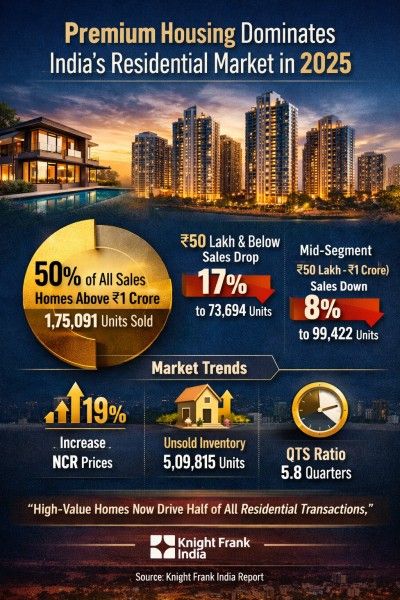
Premium housing has emerged as the dominant force in India’s residential real estate market, accounting for half of all homes sold across the country’s top eight cities in 2025, according to a new report by Knight Frank India.
In its flagship report, India Real Estate: Office and Residential Market, the consultancy highlighted a structural shift in buyer preferences, with homes priced above ₹1 crore now making up 50% of total residential sales. Of the 3,48,247 housing units sold during 2025, as many as 1,75,091 units were in the ₹1 crore-plus category, reflecting a 14% year-on-year growth. The data underscores the growing dominance of premium housing, even as overall annual sales volumes remained broadly stable at elevated levels.
The shift has been equally pronounced at the lower end of the market. The sub-₹50 lakh segment saw a sharp 17% year-on-year decline in sales, with volumes dropping to 73,694 units in 2025. This category now accounts for just 21% of total sales, compared with nearly 37% in 2022, highlighting the pace at which demand composition has changed. The mid-segment, priced between ₹50 lakh and ₹1 crore, also recorded an 8% decline to 99,422 units.
Knight Frank India CMD Shishir Baijal described the development as a defining milestone for the sector. He noted that demand is increasingly being led by financially secure end-users upgrading to better-quality homes. Improved affordability metrics, rising incomes and sustained urban confidence have enabled buyers to move up the value chain, reshaping overall housing demand.
The premium tilt has been supported by sustained price growth across major cities. Weighted average residential prices rose across all leading markets in 2025, led by NCR with a 19% year-on-year increase. Hyderabad followed with 13% growth, Bengaluru recorded a 12% rise, while Mumbai saw prices climb 7%. A higher share of new project launches in premium categories has further reinforced this trend.
Despite launches outpacing sales in several markets, overall market fundamentals remain stable. Unsold inventory across the top eight cities stood at 5,09,815 units at the end of 2025, with the quarters-to-sell (QTS) ratio steady at 5.8 quarters. This indicates relatively efficient absorption levels and disciplined supply additions.
Baijal added that premium housing has become the principal anchor of India’s residential market, with larger cities continuing to demonstrate strong absorption in higher ticket-size segments. Meanwhile, lower-priced categories remain under pressure. He said the current demand mix reflects a more mature, end-user-driven market supported by stable inventory levels and calibrated supply.
With premium homes now accounting for half of all residential transactions, the market appears to be entering a phase of consolidation driven by higher-value demand. While rapid volume expansion may moderate, stable absorption and selective price appreciation are likely to define residential market dynamics in 2026