


India’s economic narrative is being shaped not just by growth numbers, but by the credibility and sophistication of the systems that produce them. The latest Gross Domestic Product (GDP) estimates, released with a revised base year of 2022–23, signal both a resilient economy and a modernised statistical framework designed to better capture its evolving structure.
According to the new series, real GDP growth for FY 2025–26 is estimated at 7.6%, up from 7.1% in FY 2024–25. Nominal GDP, measured at current prices, is projected to expand by 8.6% during the same period. The data highlights broad-based momentum across sectors, with manufacturing recording double-digit growth in FY 2023–24 and again in FY 2025–26, reinforcing its position as a key engine of economic resilience.
The secondary and tertiary sectors have also delivered strong performance, each growing above 9% in FY 2025–26. Notably, the ‘trade, repair, hotels, transport, communication and services related to broadcasting and storage’ segment expanded by 10.1% at constant prices, reflecting robust activity in consumer-facing and logistics-linked industries.
Quarterly data further underscores this sustained trajectory. Real GDP at constant prices for the October–December quarter (Q3) of FY 2025–26 is estimated at ₹84.54 lakh crore, marking growth of 7.8%. This represents a steady acceleration from 7.1% in Q3 FY 2023–24 and 7.4% in Q3 FY 2024–25, indicating strengthening economic momentum.
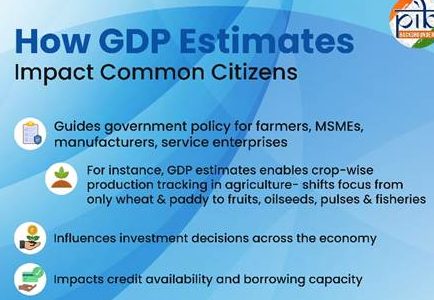
GDP, defined as the total value of final goods and services produced within a country over a given period, remains the most widely used barometer of economic health. Policymakers, businesses and financial institutions rely on its trends to guide planning, investment and strategy.
The latest estimates are compiled by the National Statistical Office under the Ministry of Statistics and Programme Implementation using the globally recognised Benchmark-Indicator methodology. This approach, aligned with the System of National Accounts (SNA) 2008 and the IMF’s Quarterly National Accounts Manual 2017, uses annual GDP as a benchmark and applies high-frequency indicators—monthly or quarterly data—to generate more timely quarterly estimates.
A central reform in the new series is the revision of the GDP base year from 2011–12 to 2022–23. The base year serves as the reference period whose prices are used to calculate real growth. The choice of 2022–23 reflects its status as the most recent “normal” year following the disruptions of the COVID-19 period between 2019 and 2021.
Rebasing allows GDP and related indicators such as the Consumer Price Index (CPI) and Index of Industrial Production (IIP) to better mirror structural shifts in the economy. Over the past decade, India has seen rapid expansion in renewable energy, digital services, and changing consumption and investment patterns. Updating the base year enables these emerging sectors and new price dynamics to be more accurately reflected.
The modernisation also leverages advances in data systems. Digital platforms such as e-Vahan, the Public Financial Management System (PFMS), and the GST network provide granular, high-frequency inputs that enhance the precision and timeliness of national accounts.
Together, these reforms strengthen transparency, global comparability and statistical credibility. As India pursues higher growth ambitions, a robust measurement framework ensures that economic progress is not only achieved—but accurately captured and trusted.