


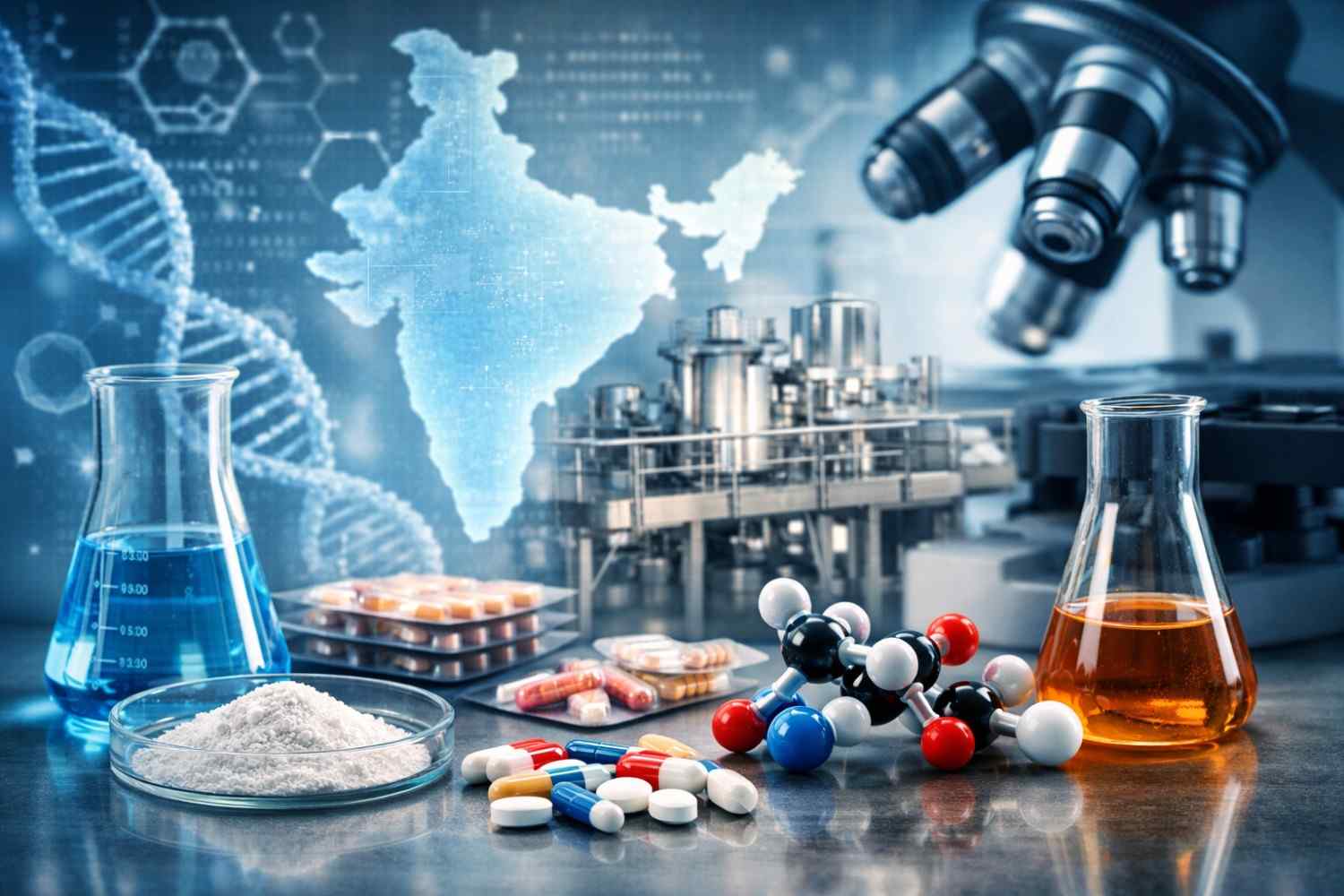
India’s Active Pharmaceutical Ingredient (API) industry, currently valued at an estimated $15–16 billion, is expected to grow at a compound annual growth rate (CAGR) of 5–7% through FY27 and FY28, according to a recent study by CareEdge Ratings.
The projected growth is underpinned by supportive government policies, a structural shift towards high-potency and complex APIs, rising domestic pharmaceutical demand and expanding penetration into regulated as well as emerging global markets.
Shift Toward Complex and High-Potency APIs
Indian pharmaceutical manufacturers are increasingly transitioning from basic, commoditised APIs to more complex and high-potency APIs (HPAPIs). The move is aimed at countering price erosion in commoditised segments, strengthening operating margins and improving long-term customer retention.
Beyond APIs, companies are also expanding into specialised areas such as contract development and manufacturing (CDMO) and finished formulations, positioning themselves higher up the pharmaceutical value chain. While pure-play API manufacturers face intensifying competition, this strategic diversification is expected to enhance pricing power, compliance standards and profitability over the long term.
Understanding the Pharmaceutical Value Chain
Drug manufacturing typically involves 8–10 stages, beginning with Key Starting Materials (KSMs), which are the primary raw materials. These are processed into APIs, the active substances responsible for a drug’s therapeutic effect, and subsequently formulated into finished dosage forms (FDFs) using excipients.
For instance, p-Aminophenol serves as a KSM in the production of acetaminophen (paracetamol), the API, which is then marketed under various branded formulations.
While KSMs are generally produced in bulk and face relatively lower regulatory scrutiny, making them cost-efficient, the maximum value addition occurs at the API and finished formulation stages, both of which are highly regulated and central to the global pharmaceutical supply chain.
Import Dependence and China Exposure
India currently imports around 30–35% of its API requirements, with nearly 70% of those imports sourced from China. China’s dominance in bulk drug manufacturing is attributed to its long-standing cost efficiencies, favourable policy environment and large-scale production infrastructure.
The COVID-19 pandemic exposed the risks of excessive concentration in supply chains. For certain antibiotics such as ciprofloxacin, erythromycin and norfloxacin, India’s dependence on Chinese imports was estimated at 80–100%, highlighting the urgency of supplier diversification and domestic capacity building.
Policy Support and PLI-Led Expansion
To reduce reliance on imported bulk drugs and intermediates, the Government of India introduced the Production-Linked Incentive (PLI) scheme in 2020 to promote domestic manufacturing of critical APIs and KSMs.
While the full impact of the scheme is expected to materialise over time, tangible progress is already visible. More than 30 projects have been completed under the initiative. Companies such as Aurobindo Pharma Limited, which has commissioned a ₹2,500 crore Penicillin G plant, along with Hetero Group, Macleods Pharma and Symbiotec Pharmalab have inaugurated new capacities to strengthen domestic supply resilience.
Technology and Sustainability Integration
In parallel, Indian API manufacturers are modernising operations through the adoption of artificial intelligence, data analytics and flow manufacturing technologies. These advancements aim to enhance production efficiency, improve sustainability metrics and ensure compliance with evolving global regulatory standards.