


India’s sustained push to improve the business environment through regulatory reforms and pro-enterprise policies is beginning to show tangible results, with a sharp rise in the number of active companies and continued optimism among businesses about future growth.
Over the past decade, the government has pursued an ambitious programme of reforms aimed at making India a more attractive destination for investment and enterprise. These efforts, built around the Ease of Doing Business (EoDB) agenda, have focused on simplifying regulations, digitising processes, and reducing compliance burdens to create a more transparent and efficient business ecosystem.
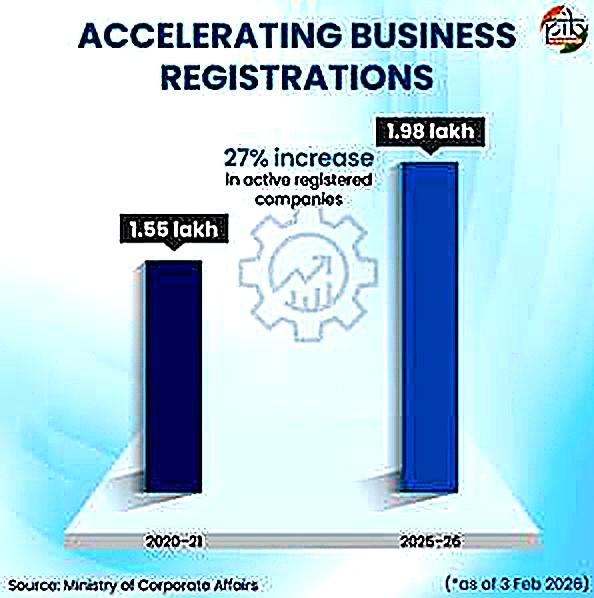
The impact of these reforms is reflected in the steady growth of India’s corporate landscape. The number of active registered companies in the country has increased by around 27% over the past five years, rising from about 1.55 lakh in 2020–21 to nearly 1.98 lakh in 2025–26 as of February 3, 2026. The expansion signals growing entrepreneurial activity and stronger investor participation in the economy.
Business sentiment indicators also point to sustained confidence among firms. The Reserve Bank of India’s Business Expectations Index has remained above the neutral benchmark of 100 throughout FY2024-25 and continued to do so in the July–September quarter of FY2025-26. The index suggests that companies expect improvements in output, employment, and investment, reflecting optimism about demand and economic prospects.
The government has positioned ease of doing business as a core pillar of its economic reform strategy. By reforming legislative frameworks, eliminating redundant compliance requirements, and streamlining administrative procedures, policymakers aim to create a predictable and investor-friendly environment that encourages innovation, entrepreneurship, and wealth creation.
The Union Budget 2026–27 has further reinforced this agenda through a series of measures designed to simplify business operations. These include initiatives to facilitate digital trade, provide greater tax certainty, reduce litigation and compliance burdens, introduce trust-based customs systems, and promote an investment-friendly tax regime.
Institutional reforms have also been a key part of strengthening India’s business ecosystem. Policies aimed at expanding access to finance, modernising trade infrastructure, and promoting technology adoption are helping enterprises scale faster while improving overall efficiency in the business environment.
A major pillar of this transformation has been the Startup India initiative, launched to encourage entrepreneurship and innovation across sectors. Under the programme, companies recognised by the Department for Promotion of Industry and Internal Trade (DPIIT) receive a range of benefits, including tax incentives, simplified compliance procedures, faster intellectual property rights processing, and regulatory support.
The initiative has played a central role in building India’s startup ecosystem. As of February 2026, the country had more than 2.16 lakh DPIIT-recognised startups, placing India among the world’s largest startup hubs.
Beyond Startup India, a range of complementary initiatives have emerged to support technological innovation, rural entrepreneurship, academic research, and regional inclusion. Together, these programmes aim to ensure that the benefits of entrepreneurship extend across sectors and geographies while aligning with the country’s broader development priorities.
As reforms continue to deepen and digitalisation accelerates, policymakers believe India’s evolving business environment will further strengthen investor confidence and position the country as a competitive global hub for trade, innovation, and investment.