


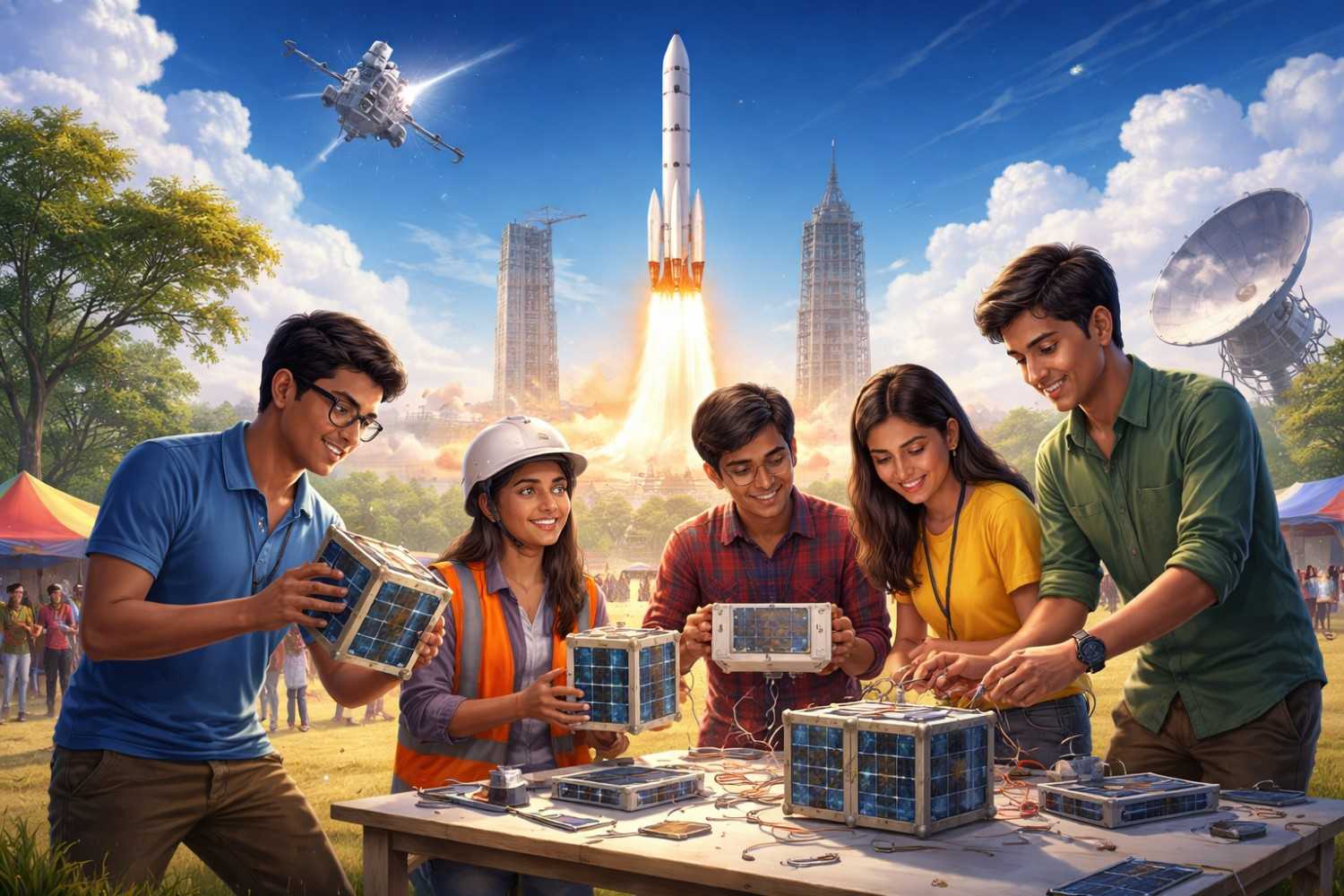
India’s space programme is increasingly turning to its young innovators. The Indian Space Research Organisation (ISRO) has significantly expanded opportunities for students and young researchers to participate in satellite development and space missions, with 11 student-built satellites already launched with official mentorship and launch support, Union Minister Jitendra Singh informed the Rajya Sabha.
The government is actively working to democratise access to space technology by enabling students from universities across India , including institutions in tier-2 and tier-3 cities , to participate in real space missions.
Students Building Real satellites
Under ISRO’s Student Satellite Programme, universities and student teams are encouraged to design and develop satellites with direct technical mentoring from scientists at the U R Rao Satellite Centre.
These projects go beyond classroom experiments. Student-built satellites receive support for integration, testing and launch aboard ISRO missions, giving young researchers real-world experience in mission development.
So far, the Indian National Space Promotion and Authorisation Centre (IN-SPACe) has authorised 17 student satellites and payloads, of which 11 have already been successfully launched, reflecting growing academic participation in India’s space ecosystem.
Competitions Spark Innovation
Student interest in space technology is also being encouraged through national design competitions. According to the Minister, 97 student teams involving nearly 850 students have participated in satellite and rocket design challenges organised by IN-SPACe.
A key highlight was the Model Rocketry and CanSat India Student Competition jointly organised by IN-SPACe, ISRO and the Astronautical Society of India.
Held in Kushinagar, Uttar Pradesh, the event saw 67 teams comprising around 500 students design, fabricate and launch model rockets carrying CanSat payloads to an altitude of about one kilometre, giving participants a simulated satellite mission experience.
Building Research Ecosystems In Universities
To expand academic collaboration, ISRO has set up Space Technology Incubation Centres (STICs) across different regions of India. These centres help universities undertake research in satellite systems, payload technologies and other advanced space applications under expert mentorship.
Complementing these efforts are Regional Academic Centres for Space (RAC-S), which serve as regional access points connecting academic institutions with ISRO programmes and research opportunities.
Through the RESPOND programme, ISRO also provides financial and technical support to universities for research in space science, space technology and applications.
Space Education Gaining Momentum
The government is also strengthening the academic pipeline for future space scientists. The All India Council for Technical Education (AICTE) has approved a Space Technology Minor Course, while a national committee has been set up to promote space technology education under the framework of the Indian Space Policy 2023.
To support outreach initiatives, the government has earmarked around ₹10 crore annually for student-focused programmes related to space science and technology.
Nurturing Next Generation Of Space Innovators
IN-SPACe is also helping nurture future space entrepreneurs by offering mentorship from industry experts, pre-incubation support programmes and co-working facilities at its technical centres.
These initiatives are part of a broader national vision to build a vibrant and inclusive space ecosystem in which students, universities, startups and industry work together to expand India’s role in the global space sector.
With student-built satellites already reaching orbit and hundreds of young researchers designing rockets and payloads, India’s space programme is increasingly becoming a launchpad for the next generation of scientists and innovators.