


India’s power sector is entering a high-growth, high-transformation phase, with installed capacity surpassing 520 GW, one of the fastest expansions globally. Backed by rising demand, policy momentum, and rapid renewable adoption, the sector is positioning itself as a cornerstone of India’s economic and industrial growth.
Electricity demand is projected to surge by over 30% by 2030, fuelled by emerging segments such as AI-driven data centres and electric mobility. Parallelly, the country’s transmission network has expanded beyond 5 lakh circuit kilometers, reinforcing grid resilience and connectivity. Renewable energy continues to lead the transformation, with solar capacity skyrocketing from 2.8 GW in 2014 to over 143 GW currently.
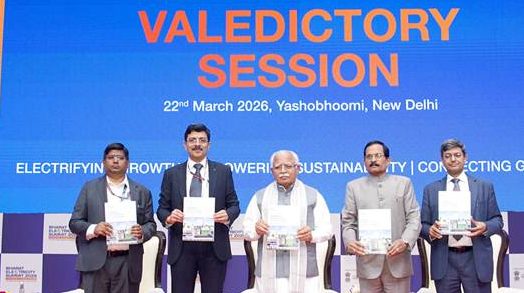
Speaking at the Bharat Electricity Summit 2026 in New Delhi, Manohar Lal Khattar highlighted that while thermal power remains essential for grid stability, the long-term trajectory will be driven by renewables, supported by storage solutions, grid modernisation, and progressive policy reforms.
Ministerial Meet Sets Reform Agenda
A high-level meeting with states and Union territories outlined critical priority areas aimed at strengthening the sector’s fundamentals. Key focus areas include improving the financial health of DISCOMs through structural and operational reforms, ensuring cost-reflective tariffs with targeted subsidies, and accelerating the nationwide rollout of smart meters.
The Centre also emphasised the need for securing adequate generation capacity tie-ups to meet future demand, alongside fast-tracking nuclear power development to enhance long-term energy security.
Infrastructure And Market Expansion Gains Momentum
India’s infrastructure build-out remains central to meeting future demand. The country will need to add over 1.37 lakh circuit km of transmission lines by 2030, requiring investments of nearly ₹9 lakh crore.
Energy storage is emerging as a critical pillar, with pumped storage potential estimated at over 200 GW. Battery Energy Storage Systems (BESS) are also gaining traction as a key solution for managing peak demand and ensuring grid stability.
On the market front, evolving renewable tariffs and improved price discovery mechanisms are enhancing investor confidence. A major milestone was the launch of the Indian Carbon Market Portal, with trading expected to commence soon, marking a significant step in advancing climate finance.
Digital Transformation Redefines Power Ecosystem
Digitalisation is rapidly reshaping India’s power landscape. The integration of Artificial Intelligence, Machine Learning, and digital twins is enabling predictive and intelligent grid operations.
The proposed “India Energy Stack,” inspired by the success of digital public infrastructure, aims to create seamless and interoperable energy systems. Consumer-centric initiatives such as smart metering and rooftop solar are transforming users into “prosumers,” allowing them to actively participate in energy generation and consumption.
A Future Anchored In Resilience And Global Leadership
The Bharat Electricity Summit 2026 has laid out a clear roadmap for the sector—centred on resilience, sustainability, and technological leadership. The outcomes are expected to play a pivotal role in shaping future policies, strengthening partnerships, and accelerating India’s transition towards a reliable, affordable, and clean energy ecosystem.
With strong policy backing, rising investments, and technological innovation, India is poised to emerge as a global leader in the energy transition while catering to domestic demand and supporting the Global South