


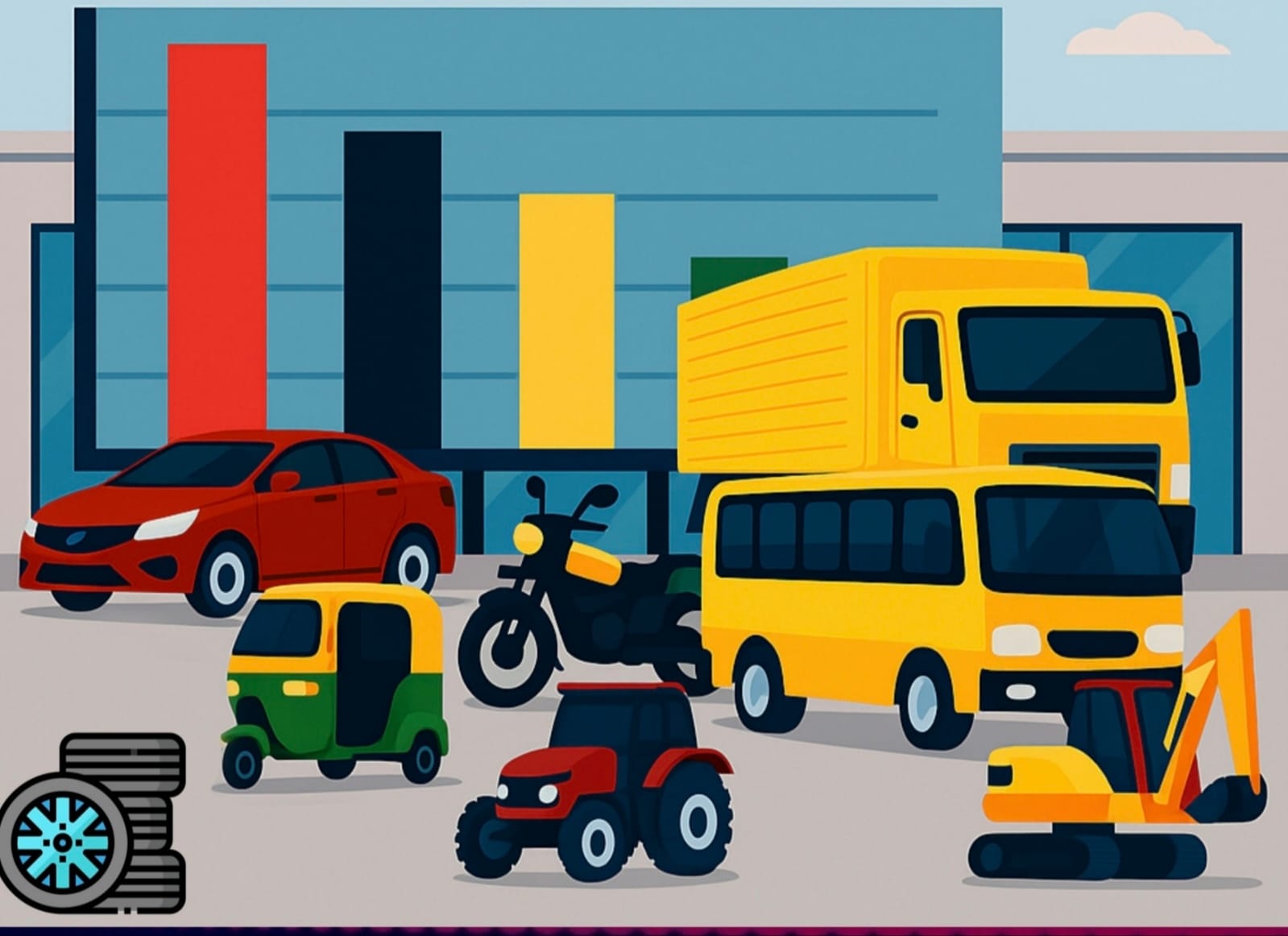
India’s automobile retail sector delivered a landmark performance in FY26, clocking an all-time high of 2.96 crore units, marking a 13.3% year-on-year (YoY) growth. According to Federation of Automobile Dealers Associations, five of the six vehicle categories recorded their best-ever annual sales, underlining strong and broad-based demand.
Two-wheelers and PVs lead growth
Two-wheelers led the recovery, surpassing pre-pandemic levels with over 2.14 crore units sold, growing 13.4% YoY. Improved affordability, stronger rural cash flows, and a wider product mix drove this revival.
Passenger Vehicles (PVs) also hit a new high, crossing 47 lakh units with 13% growth, supported by new launches, rising urbanisation, and continued preference for SUVs and alternative powertrains.
Tractors, CVs and 3Ws shine; construction equipment lags
Tractors emerged as the standout segment, crossing 10 lakh units for the first time with a robust 18.95% growth, aided by a strong monsoon and improved farm economics.
Commercial Vehicles (CVs) also achieved record sales, growing 11.74%, driven by infrastructure-led demand, while Three-Wheelers registered their third consecutive record year with 11.68% growth, led by rapid EV adoption.
Construction Equipment was the only laggard, declining 11.7% due to project delays and a high base.
EV and alternative fuel adoption accelerates
The transition to cleaner mobility gained momentum in FY26. Electric vehicle (EV) penetration rose across segments, 2W EV share reached 6.54%, PVs 4.25%, and CVs 1.83%.
CNG continued to strengthen its presence, accounting for 21.98% in PVs and 11.79% in CVs. Total EV retail volumes stood at 24.52 lakh units, up 24.63% YoY, signalling a structural shift in the market.
Rural demand narrows urban gap
Rural markets nearly matched urban growth, expanding 13.05% YoY compared to 13.62% in urban areas. Notably, rural demand outpaced urban in the PV segment, highlighting rising aspirations and improved connectivity in hinterland markets.
Improved inventory and financing conditions
Dealer inventory levels saw a sharp correction, with PV stock reducing from over 50 days to around 28 days, reflecting better alignment between supply and demand.
Financing conditions also improved in the second half of the year, with increased lender appetite and competitive loan offerings boosting retail momentum, particularly in mass segments.
Strong finish in March 2026
March 2026 capped the year with record monthly sales of 26.92 lakh units, up 25.28% YoY.
Two-wheelers led with 19.51 lakh units (+28.68%), while PVs recorded 4.40 lakh units (+21.48%). CV sales stood at 1.02 lakh units (+15.12%), driven by strong performance in the medium commercial vehicle segment.
EV adoption also accelerated during the month, especially in two-wheelers, where penetration touched 9.79%, indicating growing consumer acceptance.
FADA president C S Vigneshwar said: “This is not just a number, it represents the industry approaching the 3-crore mark, a milestone that would have seemed distant just two years ago. What makes this year particularly significant is that the growth was structurally sound, underpinned by improving affordability, widening mobility demand across urban and rural India, and a diversifying powertrain mix.”