


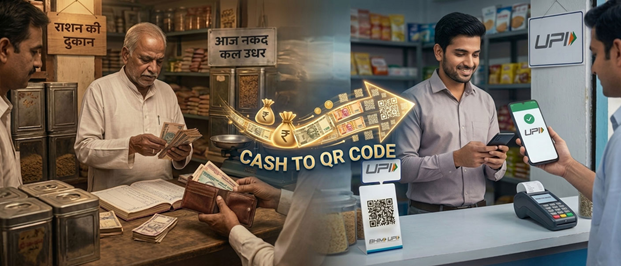
Not long ago, a simple financial transaction demanded time, effort, and patience. Paying bills meant standing in long queues. Sending money required a visit to the bank, filling out forms, and waiting days for confirmation. For millions in India without access to banking, it meant exclusion from the financial system itself. That India, however, is now the past.
From cash dominance to early digitisation
India’s financial journey has evolved over centuries, from barter systems and cowrie shells to coins, paper currency, and cheques. For much of its modern history, cash remained the dominant mode of transaction. While cheques and demand drafts formalised payments, they were slow and accessible only to a limited segment. Banking infrastructure was largely urban-centric, leaving rural and remote populations underserved.
Significant milestones
The early 2000s marked the beginning of digital transformation in payments. The Reserve Bank of India introduced systems like Real-Time Gross Settlement (RTGS) in 2004 and Immediate Payment Service (IMPS) in 2010, enabling faster and round-the-clock transfers. These were significant milestones, but their reach remained limited to those already within the banking ecosystem, and access to formal financial services remained constrained for many.
The need for a structural shift
A large segment of India’s population remained outside formal finance, without access to credit, insurance, or secure savings. The absence of a scalable, inclusive, and real-time digital infrastructure meant that the benefits of economic growth could not fully reach everyone. The need for a transformational shift was clear, setting the stage for India’s digital payments revolution.
UPI: simplifying money movement
In 2016, the National Payments Corporation of India launched the Unified Payments Interface (UPI), fundamentally simplifying how money moves in India. At its core, UPI enables any bank account to connect with another through a Virtual Payment Address, removing the need to share detailed banking information.
Instant transfers is the highlight
The idea of UPI lies in its simplicity, no account numbers to memorise. It replaces complex inputs like account numbers and IFSC codes with a simple interface. Users only need a mobile number, a UPI ID, and secure authentication to initiate instant transfers. Transactions are processed in real time, available round the clock, and seamlessly interoperable across banks and applications.
A unified payments infrastructure
This interoperability has been central to UPI’s rapid expansion. From 216 banks in 2021 to 691 by January 2026, the network has evolved into a unified payments infrastructure, enabling users to transact effortlessly regardless of their bank or platform. Its low-cost architecture has reduced barriers for individuals and merchants while encouraging innovation among banks and fintech players.
Beyond convenience: driving inclusion
UPI has moved beyond simplifying payments to reshaping participation in the financial system. By enabling instant, low-cost transactions, it has reduced dependence on cash, improved efficiency, and expanded access to formal finance for millions. For small merchants and informal workers, this shift is especially significant, creating new pathways to credit, insurance, and savings.
Transactions across the spectrum
The real story lies not in transaction volumes, but in who is transacting. Autorickshaw drivers accept payments through QR codes. Village mandis settle transactions instantly. Street vendors no longer struggle with change. A domestic worker can send money across states in seconds using a basic smartphone. In this system, the divide between urban and rural, formal and informal, is steadily narrowing, marking a decisive shift towards financial inclusion.