


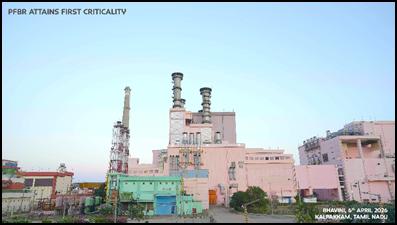
India has crossed a defining milestone in its nuclear energy journey, with the indigenously built Prototype Fast Breeder Reactor (PFBR) at Kalpakkam achieving first criticality on April 6, 2026. The milestone marks the initiation of a sustained nuclear chain reaction and formally signals India’s entry into the second stage of its long-envisioned three-stage nuclear power programme.
Developed by Bharatiya Nabhikiya Vidyut Nigam Ltd (BHAVINI), the 500 MWe reactor is located at the Kalpakkam Nuclear Complex in Tamil Nadu. The achievement places India among a select group of nations, with the country set to become only the second after Russia to operate a commercial fast breeder reactor once the PFBR is fully operational.
Strategic leap in clean energy transition
The development reflects decades of sustained scientific effort led by the Department of Atomic Energy and reinforces India’s commitment to expanding its low-carbon energy base. Beyond technological significance, the PFBR is a crucial step towards energy security and aligns with India’s net zero target for 2070.
The milestone also advances the vision of Dr. Homi Jehangir Bhabha, who conceptualised a three-stage nuclear programme tailored to India’s resource profile—limited uranium but abundant thorium reserves.
Three-stage programme gains momentum
India’s nuclear roadmap is built on a closed fuel cycle designed to maximise domestic resources.
Stage one relies on Pressurised Heavy Water Reactors (PHWRs) using natural uranium, producing plutonium as a by-product. This plutonium fuels stage two, where fast breeder reactors like the PFBR generate more fissile material than they consume. The third stage will leverage thorium reserves, converting them into Uranium-233 for large-scale energy generation.
The PFBR serves as a critical bridge between stages two and three, enabling the eventual transition to a thorium-based energy ecosystem.
Technology and design highlights
The PFBR represents a fully indigenous engineering achievement, with core technologies developed by the Indira Gandhi Centre for Atomic Research (IGCAR).
Unlike conventional reactors, it uses uranium-plutonium mixed oxide (MOX) fuel and operates on fast neutron technology. A uranium-238 blanket surrounding the core enables the breeding of plutonium-239, effectively generating more fuel. The design also allows future integration of thorium to produce uranium-233, closing the nuclear fuel cycle and strengthening long-term sustainability.
Nuclear energy poised for expansion
India’s nuclear capacity currently stands at 8.78 GW, contributing about 3.1% to total electricity generation. However, the sector is on the cusp of rapid expansion, with capacity projected to reach 22.38 GW by 2031–32 through a mix of indigenous and internationally supported reactors.
Parallelly, India has signed civil nuclear cooperation agreements with 18 countries, underlining growing global confidence in its nuclear capabilities.
Long-term vision backed by policy push
The government’s Nuclear Energy Mission, outlined in the Union Budget 2025–26, targets 100 GW of nuclear capacity by 2047. A ₹20,000 crore allocation has been earmarked for the development of Small Modular Reactors (SMRs), with at least five expected to be operational by 2033.
Research initiatives led by the Bhabha Atomic Research Centre (BARC) include next-generation designs such as the Bharat Small Modular Reactor (BSMR-200) and hydrogen-focused high-temperature reactors.
Complementing these efforts, the SHANTI Act, 2025, modernises India’s nuclear regulatory framework and enables calibrated private sector participation, opening new avenues for investment and collaboration.