


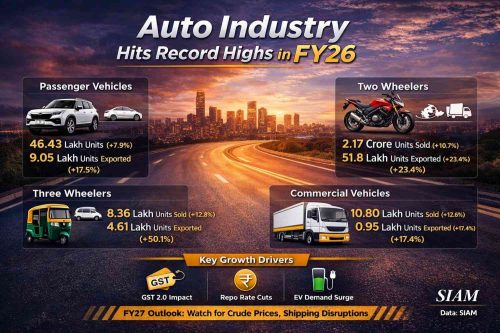
India’s passenger vehicle segment clocked its highest-ever sales of 46.43 lakh units in FY26, posting a growth of 7.9% compared to the previous financial year.
Demand drivers and policy support
This robust performance was supported by improved affordability following the GST rate reduction, enhanced purchasing power from personal income tax relief, and lower financing costs due to successive repo rate cuts by the RBI, according to auto industry data released by Society of Indian Automobile Manufacturers (SIAM).
Passenger vehicle exports surge
Passenger vehicles also recorded their highest-ever exports of 9.05 lakh units in FY26, registering a growth of 17.5% over FY25. Demand remained steady across key markets, including West Asia, Africa, and Latin America.
Two-wheeler segment hits new peak
For FY26, the two-wheeler segment posted its highest-ever sales of 2.17 crore units, with a growth of 10.7%, surpassing the previous peak achieved in FY19.
Second half growth momentum
The implementation of GST 2.0 spurred growth in both Q3 and Q4 of FY26. While H1 growth remained flat at below 1%, H2 recorded growth of around 21.5% compared to the previous H2.
Additionally, EV offtake increased in March, driven by expectations of rising fuel prices. Growth was observed across both urban and rural markets, although the current trend has been led primarily by urban demand.
Two-wheeler exports at record high
Two-wheelers also recorded their highest-ever exports in a financial year, with 51.8 lakh units in FY26, reflecting a growth of 23.4% over FY25.
A wider product range, global recognition of Indian brands, and robust quality have boosted international acceptance. The depreciating value of the rupee has further supported export volumes.
Three-wheeler segment growth
Three-wheelers posted their highest-ever sales of 8.36 lakh units in FY26, registering a growth of 12.8% compared to FY25.
Mobility demand fuels segment
The performance of the three-wheeler segment was driven by increased economic activity, rising movement of people and goods, and strengthening mobility needs in urban and semi-urban areas.
Demand was further supported by the expansion of electric autorickshaws and the issuance of new permits for ICE three-wheelers by select state governments.
Exports gain traction
Exports of three-wheelers grew by 50.1% in FY26, reaching around 4.61 lakh units. Increased shipments to Sri Lanka and African nations contributed significantly to this growth.
Commercial vehicles see strong growth
The commercial vehicle segment posted its highest-ever sales of 10.80 lakh units in FY26, with a growth of 12.6% over FY25. Exports stood at around 0.95 lakh units, reflecting a growth of 17.4%. Neighbouring countries and West Asia remained steady markets for commercial vehicles.
Outlook for FY27
FY26 has been a landmark year for the Indian automobile industry, supported by structural policy reforms that strengthened demand fundamentals and boosted consumer confidence.
The industry remains optimistic, expecting growth to continue across all vehicle categories in FY27, building on strong momentum from the latter half of FY26.
Risks and uncertainties
However, uncertainties arising from the West Asia conflict—particularly crude oil and commodity prices, higher exchange rates, and disruptions in shipping routes—remain key concerns for the auto sector. A stable geopolitical environment will be crucial to sustaining growth momentum.
Industry perspective
Commenting on the FY26 performance, SIAM President Shailesh Chandra said, “Though FY 2025-26 started modestly, the Indian auto industry has closed the year on a high note, with every vehicle category posting its highest-ever sales in a financial year after seven years. The strong contributors to this growth have been the positive sentiment created through GST 2.0 reforms and multiple repo rate cuts during the year.”