


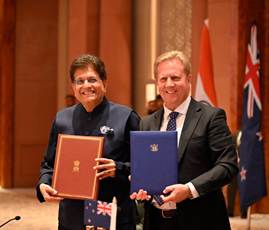
India has added another strategic pillar to its global trade playbook, signing a landmark Free Trade Agreement with New Zealand that signals deeper economic integration with developed markets.
The India–New Zealand Free Trade Agreement (IN–NZ FTA) was signed by Piyush Goyal and Todd McClay, marking what both sides describe as a transformative moment in bilateral ties.
A Defining trade milestone
Calling it a “once-in-a-generation” opportunity, McClay underscored the agreement’s potential to boost exports, create jobs, and unlock stronger economic linkages between the two countries. He highlighted robust participation from New Zealand businesses at the signing ceremony and noted that the pact will ease market access, reduce trade barriers, and provide a significant push to MSMEs.
For India, the agreement represents more than just another trade deal, it is a continuation of its aggressive push to deepen engagement with advanced economies.
Goyal described the FTA as a defining milestone aligned with Prime Minister Narendra Modi’s vision of building global economic partnerships that benefit farmers, youth, women, artisans, and entrepreneurs. He emphasised that the agreement focuses on export growth, agricultural productivity, student mobility, skills, investment, and services.
Speed, scale and strategic intent
One of the standout aspects of the deal is its pace. Concluded in just nine months after five formal rounds of negotiations and multiple intersessions, it is among the fastest FTAs India has signed with a developed nation.
The agreement also comes with a strong investment signal. New Zealand has committed around $20 billion in investments, reflecting confidence in India’s growth trajectory. Additionally, the pact opens access across 118 sectors, with Most Favoured Nation (MFN) commitments spanning 139 sectors.
Goyal noted that this is India’s ninth trade agreement in recent years, covering 38 developed countries and nearly 65–70% of global GDP. He also pointed to ongoing negotiations with the European Union and the United States, indicating that India’s trade expansion strategy is far from over.
Trade, talent and technology
Beyond tariffs and market access, the FTA expands into future-focused areas such as services, mobility, agriculture productivity, organics, AYUSH, and pharmaceuticals—broadening the scope of bilateral cooperation.
Commerce Secretary Rajesh Agrawal described the agreement as the beginning of a new era defined by trust and complementary strengths, adding that it creates a level playing field for Indian exports into New Zealand.
Strengthening Indo-Pacific ties
The agreement is anchored in strong people-to-people connections and a shared vision between two vibrant democracies to deepen trade and strategic engagement across the Indo-Pacific.
Trade numbers already point to a growing relationship. India’s merchandise trade with the Oceania region stood at around $26 billion in 2024–25, with New Zealand emerging as India’s second-largest trading partner in the region, clocking bilateral trade of approximately $1.3 billion.
With the FTA set to come into force, both sides expect a sharp uptick in trade volumes, driven by improved market access, streamlined processes, and stronger business collaboration.