


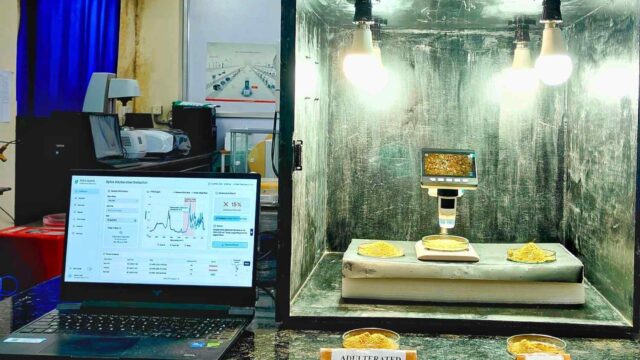
National Institute of Technology Rourkela (NIT Rourkela) has secured a patent for a breakthrough system capable of rapidly detecting and quantifying adulteration in spices and other food products, marking a significant step forward in food safety technology.
Developed by researchers at the institute, the system combines Fourier Transform Infrared (FTIR) spectroscopy with advanced machine learning models to deliver fast, accurate, and non-destructive testing. The innovation addresses a persistent challenge in the food industry, particularly in India, where adulteration remains a major health and economic concern.
Traditional detection methods such as chromatography and molecular techniques are often time-consuming, resource-intensive, and unsuitable for routine or real-time testing. In contrast, the NIT Rourkela system provides results within seconds, making it highly viable for deployment in quality control labs and food processing units.
Research and validation
The patented technology, titled “Method and System for Detecting and Quantifying Adulteration in Food Stuff , has been developed by Assistant Professor Sushil Kumar Singh, along with the late Poonam Singha and M.Tech graduate Rishabh Goyal from the Department of Food Process Engineering. The findings have also been published in the Food Chemistry journal.
As part of the study, the research team demonstrated the system’s effectiveness by detecting sawdust adulteration in coriander powder, a common malpractice. The model achieved an accuracy of around 92%, while also establishing a scalable framework for identifying multiple adulterants across diverse food categories.
Industry relevance and next steps
Sushil Kumar Singh said the innovation addresses the long-standing need for a fast and reliable adulteration detection system, combining rapid testing equipment with intelligent decision-making capabilities. He added that the system can be seamlessly integrated into existing quality control workflows, enabling real-time screening for both large enterprises and SMEs.
Beyond efficiency, the system offers a cost advantage by eliminating complex sample preparation, reducing reliance on chemical reagents, and lowering operational expenses—an important factor in price-sensitive markets like India.
The research team is now looking to collaborate with industry partners for pilot-scale validation and expand the system’s capabilities beyond spices to a broader range of food products.
With rising concerns around food safety, such innovations are expected to strengthen regulatory compliance, improve supply chain transparency, and enhance consumer trust across the food ecosystem.