


A research group at National Institute of Technology Rourkela (NIT Rourkela) has created a lightweight material that can be used in developing aircraft landing gear with high durability. Aircraft landing gear must possess durability to endure wear and tear during landing and taxiing.
Existing material limitations
Typically made of aluminium and aluminium alloys, aircraft landing gear are designed to absorb the weight of the aircraft and must endure contact with the runway. Such conditions rapidly wear the gear material. While aluminium and aluminium alloys are lightweight in nature, their durability under such high-stress conditions remains a limitation.
Research team and development
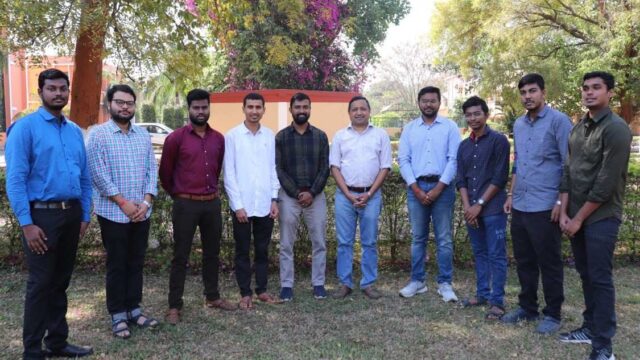
To address this gap, Prof. Syed Nasimul Alam, Associate Professor, Metallurgical and Materials Engineering, NIT Rourkela, along with his research scholar group, including Dr. Arka Ghosh, Dr. Ashutosh Das, Dr. Pankaj Shrivastava, Nityananda Sahoo, Parth Patel, and Dr. Velaphi Msomi from the University of South Africa, has developed a novel nanocomposite material that can be used for aircraft landing gear.
Publication details
The findings of this research have been published in the prestigious Materials Letters journal.
What are nanocomposites
Nanocomposites are a mixture of materials at the nanoscale level and are more than 100,000 times thinner than a human hair.
Material composition and process
To achieve the desired results, the NIT Rourkela research group used carbon nanotubes for better compressive strength and load-bearing capacity. The addition of graphite nanoplatelets further improved the nanocomposite. To make the mixture thermally stable, the research team used hexagonal boron nitride, resulting in better strength, toughness, and performance of aluminium. For even dispersion of particles in the aluminium matrix, high-frequency sound waves were applied.
Manufacturing technique
The mixed components were then put under high-pressure compaction, followed by heating and compression in an oxygen-free environment, which resulted in a dense and strongly bonded nanocomposite suitable for aerospace applications.
Expert insight
Elaborating on the developed nanocomposite, Prof. Syed Nasimul Alam said, “The Al-based hybrid nanocomposites developed by spark plasma sintering (SPS) show a uniform dispersion of the nanofiller in the Al matrix and excellent wear resistance due to the synergistic load-bearing mechanism.”
Performance advantages
The developed process produces a three-dimensional reinforcing network, which enhances load transfer and structural stability. With the help of a thin protective layer formed on its surface, the research team found that wear in the developed composite was significantly reduced.
Applications and potential
With real-world potential for use in defence aircraft and Unmanned Aerial Vehicles (UAVs), where lightweight and durability are essential, the developed nanocomposite can improve structural reliability and contribute to safer and more efficient aerospace operations.
Cost-effectiveness
In comparison to ultra-high-strength steels, titanium alloys, and high-strength aluminium alloys currently used for developing aircraft landing gear, the developed nanocomposites can offer approximately 40–60% higher overall cost-effectiveness.
Conclusion
The research team concluded that the developed material’s combination of lightweight properties and wear resistance will make landing gear more durable and safer. With key benefits such as reduced maintenance costs and improved reliability, the developed nanocomposite highlights the potential for a transformative impact in today’s energy-constrained world.
Next steps
As a next step, the team is working towards developing large-sized components made from these hybrid nanocomposites by the Powder Metallurgy (PM) route.
Policy alignment
Aligning with the Government of India’s Atmanirbhar Bharat initiative, this innovation from NIT Rourkela will help position the country as a potential contributor to next-generation aerospace materials.