


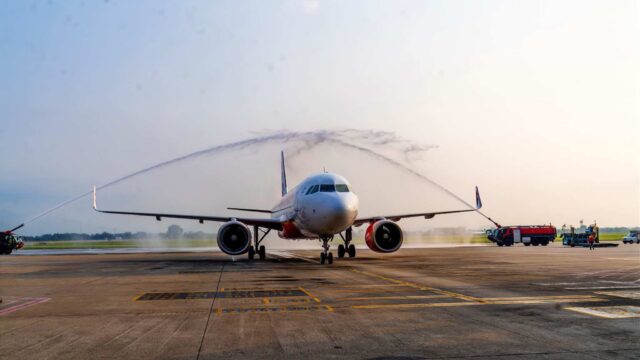
Air India’s launch of a five-times weekly non-stop service between Delhi and Hanoi may look like a routine network expansion at first glance, but the timing and structure of this move reveal a deeper strategic play in Southeast Asia, particularly in the fast-rising Vietnam corridor.
Vietnam moves from fringe to focus market
For years, Vietnam sat on the periphery of Indian outbound travel. That has changed sharply. Leisure demand has surged, driven by visa ease, competitive pricing, and a growing appetite for short-haul international holidays. At the same time, trade and business exchanges between India and Vietnam have steadily expanded.
By adding Hanoi as its second gateway after Ho Chi Minh City, Air India is not just increasing capacity, it is signalling that Vietnam is now a core, multi-city market rather than a single-destination play.
Creating more choice, greater convenience
Air India Chief Commercial Officer Nipun Aggarwal said: “Vietnam has rapidly evolved into a high-potential market for Indian travellers, supported by strong leisure demand, growing business exchanges and rising interest in multi-city holidays. With Hanoi joining our network alongside Ho Chi Minh City, we are creating more choice, greater convenience and stronger connectivity between the two countries as well as enabling traffic between Europe and Vietnam.”
Network strategy: building a dual-city corridor
The real significance lies in how the airline is structuring the network. With daily flights to Ho Chi Minh City and now a five-times weekly service to Hanoi, Air India is effectively creating a dual-entry, dual-exit corridor.
This enables “open-jaw” itineraries, fly into Hanoi, return from Ho Chi Minh City, or vice versa, something increasingly popular among leisure travellers and even business visitors looking to maximise short trips.
Such flexibility is not just a customer convenience feature; it is a yield optimisation strategy. Multi-city itineraries typically command better pricing and improve aircraft utilisation across routes.
Delhi hub play gains traction
Another layer of strategy is the strengthening of Delhi as a global connecting hub. The Hanoi service is designed to plug into Air India’s wider long-haul network, particularly traffic flows from the UK and Europe.
Instead of relying solely on point-to-point India–Vietnam traffic, Air India is positioning itself as a connector between Europe and Southeast Asia. This is a space traditionally dominated by Gulf carriers and Southeast Asian airlines.
If executed well, this hub-and-spoke model could help Air India capture higher-margin transit passengers, a key lever in improving international route profitability.
Product positioning: full-service differentiation
Deploying an A320neo with a three-class configuration, Business, Premium Economy, and Economy, on a relatively short-haul route is also telling. It reflects Air India’s attempt to differentiate itself from low-cost carriers that dominate much of the Southeast Asia traffic.
Premium Economy, in particular, is emerging as a sweet spot for Indian travellers seeking comfort without business-class pricing. Extending this product to routes like Hanoi indicates a push to standardise the premium experience across the network.
Competitive context: a crowded but growing corridor
The India–Vietnam sector is becoming increasingly competitive, with multiple Indian and foreign carriers adding capacity. However, demand growth has so far kept pace with supply.
Air India’s advantage lies in its integrated network, few competitors can combine domestic feed, long-haul connectivity, and full-service offerings in one package. The Hanoi addition strengthens that positioning.