


As India charts its path towards becoming a Viksit Bharat by 2047, manufacturing is emerging as a central pillar of economic transformation, driving growth, job creation, and global competitiveness.
Policy push and infrastructure-led growth
Government policy, as reflected in the Economic Survey and Union Budgets, continues to prioritise manufacturing through infrastructure-led development and integrated industrial ecosystems. A key shift is the move from project-based execution to system-level planning, improving logistics efficiency, reducing bottlenecks, and enabling faster industrial expansion.
At the same time, Tier-2 and Tier-3 cities are gaining prominence as manufacturing hubs, offering cost advantages, access to local talent, and improving connectivity. This decentralised approach is expected to make growth more inclusive and resilient.
Manufacturing’s growing economic role
Currently contributing around 16–17% to GDP and employing over 27 million people, manufacturing is poised for a significant scale-up. As India targets a $30–35 trillion economy by 2047, the sector’s share is expected to rise to at least 25%, underlining its strategic importance.
A notable trend is the shift towards higher-value production, with medium- and high-technology segments now accounting for over 46% of manufacturing value added—signalling a gradual move up the industrial value chain.
Rise of integrated manufacturing hubs
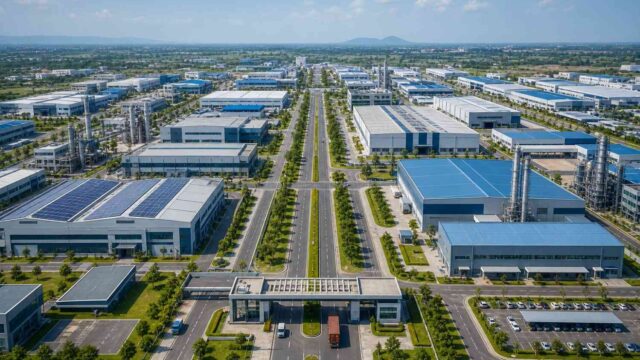
India’s manufacturing strategy increasingly revolves around integrated hubs—well-planned industrial ecosystems combining infrastructure, logistics, regulatory support, and shared facilities. These hubs are designed to reduce costs, enable scale, and attract long-term investments.
The National Industrial Corridor Development Programme (NICDP) is a key driver, with 20 industrial smart cities approved across seven corridors and 13 states. Four, Dholera, Shendra-Bidkin, Greater Noida, and Vikram Udyogpuri, are already operational, while others are at various stages of development. These hubs offer plug-and-play infrastructure and multimodal connectivity, accelerating project implementation.
Similarly, the PM MITRA scheme is building large textile-focused manufacturing zones across seven states, integrating the entire value chain from processing to logistics within a single ecosystem.
Sector-specific ecosystems gain traction
Beyond large hubs, sector-focused manufacturing ecosystems are expanding across pharmaceuticals, electronics, and biotech.
The Bulk Drug Park Scheme is enabling cost-efficient pharmaceutical manufacturing through shared infrastructure in Gujarat, Himachal Pradesh, and Andhra Pradesh. Meanwhile, initiatives like the Semicon India Programme and ECMS 2.0 are strengthening capabilities in semiconductors and electronics.
In biotech, the Biopharma SHAKTI initiative, with an outlay of ₹10,000 crore, aims to position India as a global manufacturing hub in the sector.
MSMEs anchor regional growth
Micro, Small and Medium Enterprises (MSMEs) remain the backbone of India’s manufacturing landscape. Contributing over 35% of output and nearly half of exports, the sector comprises more than 7.4 crore enterprises and employs over 32 crore people.
MSMEs play a critical role in Tier-2 and Tier-3 clusters, where shared skills, supplier networks, and lower costs create strong local manufacturing ecosystems.
The road ahead
India’s manufacturing landscape is evolving into a multi-layered ecosystem, spanning large industrial parks, sector-specific hubs, and MSME clusters. With sustained policy support, infrastructure investment, and regional diversification, manufacturing is set to drive India’s long-term economic ambitions while strengthening its position in global supply chains.