


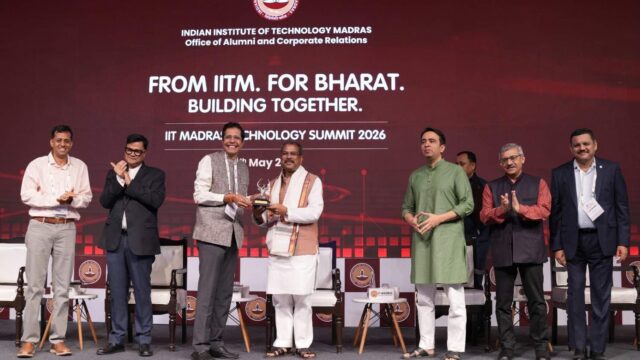
India’s innovation agenda took a decisive step forward as Indian Institute of Technology Madras (IITM) hosted its first-ever Technology Summit in New Delhi, bringing together policymakers, industry leaders, and academia to fast-track the country’s journey towards a technology-driven economy.
Inaugurated by Dharmendra Pradhan, Union Minister of Education, the summit, held at Bharat Mandapam, was themed “From IITM. For Bharat. Building Together,” reflecting a strong push to convert research into real-world, scalable solutions.
From research to real-world impact
Setting the tone, Pradhan emphasised that India’s innovation ecosystem is at a critical inflection point. While institutions like IIT Madras have built strong research capabilities, the next phase must focus on translating academic work into commercially viable products and technologies.
“Research should not remain confined to theses, it must deliver tangible outcomes for society and industry,” he said, highlighting the government’s increasing focus on strengthening R&D through Centres of Excellence and a proposed ₹1 lakh crore fund to support innovation, particularly in the private sector and startup ecosystem.
He also pointed to a structural gap: Indian talent continues to develop cutting-edge technologies globally, yet domestic industries often end up importing these solutions. Bridging this gap, he noted, will be key to building a self-reliant innovation ecosystem.
IIT Madras doubles down on collaboration
At the heart of the summit was IIT Madras’ strategy to deepen industry–academia partnerships and accelerate technology deployment at scale.
Under the government’s Institute of Eminence (IoE) framework, IIT Madras has already established 15 Centres of Excellence, mobilized over ₹950 crore in research funding, generated more than 240 patents, and incubated over 40 deep-tech startups in the past seven years.
Director V. Kamakoti described the summit as a “call to action” for collaborative innovation.
“IIT Madras is committed to working with industry, corporates, and policymakers to translate research into impactful solutions and accelerate India’s progress towards Viksit Bharat by 2047,” he said.
Strategic industry partnerships unveiled
A major highlight of the summit was the launch of new research centres in partnership with leading corporates, signaling a shift towards mission-driven innovation:
NTPC Centre for Cardiovascular Research with NTPC Limited, focused on addressing India’s rising heart disease burden through indigenous device development, genetic research, and digital diagnostics.
YANTRAS – BPCL Centre for Robotic Surgeries with Bharat Petroleum Corporation Limited, aimed at advancing robotic-assisted surgical technologies and fostering innovation in medical robotics.
HSBC Centre for Resource Efficiency and Circularity with HSBC, dedicated to developing sustainable solutions for energy transition, recyclability, and resource efficiency.
These collaborations underline a broader push to align research priorities with national needs—ranging from healthcare and advanced manufacturing to clean energy.
AI in education gets a boost
The summit also saw the launch of Bodhan AI, a Centre of Excellence focused on artificial intelligence in education. Supported by the Ministry of Education, the initiative aims to build the Bharat EduAI Stack, a digital public infrastructure for education—and train over one million teachers in AI-enabled pedagogy by 2027.
Building a collaborative innovation ecosystem
IIT Madras leadership highlighted that modern industry partnerships are evolving beyond funding into deeper collaboration, spanning problem identification, interdisciplinary research, and commercialisation.
Prof. Ashwin Mahalingam, Dean (Alumni and Corporate Relations), emphasised that the institute’s success lies in its ability to take research to the “last mile,” ensuring real societal impact.
Similarly, Kaviraj Nair, CEO of the Office of Institutional Advancement, noted that such partnerships enable industry to access frontier research while building long-term innovation pipelines.