


Indofast Energy has closed FY26 with a strong growth performance, marked by rapid infrastructure expansion, deeper OEM partnerships, and a growing footprint across India’s electric mobility landscape.
The battery-swapping solutions provider has emerged as one of the fastest-scaling players in the segment, crossing key milestones that underline its role in accelerating EV adoption, particularly in the two-wheeler and three-wheeler segments.
Scale, partnerships drive growth
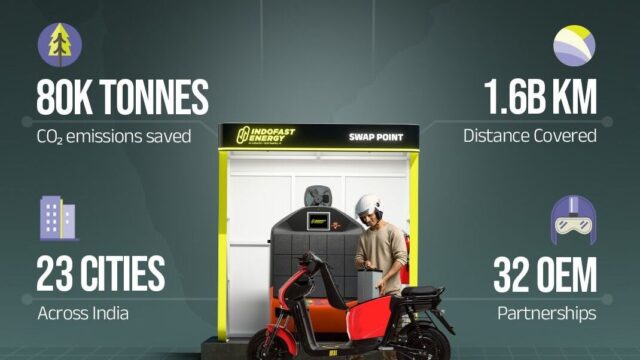
During the year, Indofast Energy onboarded over 90,000 electric vehicles onto its platform, while expanding its network to 1,600 battery-swapping stations across 23 cities. The company also strengthened its ecosystem by partnering with 32 OEMs, creating a robust and interoperable network for EV users.
Collectively, the network has powered over 1.6 billion kilometres of clean mobility, contributing to an estimated reduction of 80,000 tonnes of CO₂ emissions, highlighting the environmental impact of its expanding footprint.
Expanding beyond metros
A key feature of Indofast’s growth strategy in FY26 has been its push beyond metro cities into Tier II and Tier III markets. This expansion has been complemented by a diversification of use cases, spanning personal mobility, gig economy fleets, quick commerce, e-commerce logistics, food delivery, and shared mobility.
By targeting high-usage, high-uptime segments, the company is positioning battery swapping as a practical and scalable alternative to conventional EV charging.
Strengthening the ecosystem
The company forged multiple strategic partnerships during the year with mobility players and OEMs such as Motovolt Mobility, Quantum Energy, and Bike Bazaar, among others. These collaborations are aimed at expanding the availability of battery-swapping compatible vehicles while improving affordability and operational efficiency for end users.
On the infrastructure front, Indofast partnered with key institutions including Mumbai Metro Rail Corporation, Indian Railways, and BESCOM, as well as urban retail hubs like Nexus Select Trust.
The integration of battery-swapping stations into transit corridors and high-footfall locations is helping bring EV infrastructure closer to daily users, improving accessibility and convenience.
Solving for uptime and efficiency
At the core of Indofast’s proposition is its two-minute battery swap model, designed to eliminate range anxiety and significantly reduce downtime. This has proven particularly valuable for gig workers and fleet operators, where vehicle uptime directly impacts earnings.
The growing network is enabling better asset utilisation across sectors such as last-mile delivery, quick commerce, and logistics, areas that demand high-frequency usage and operational reliability.
CEO Anant Badjatya described FY26 as a ‘defining year’ for the company. “From scaling our station footprint and onboarding thousands of vehicles to building strong partnerships across OEMs and infrastructure players, we are committed to powering everyday India. Battery swapping will play a critical role in making EVs more accessible, affordable, and scalable,” he said.
Roadmap: scaling the next phase
Building on the momentum, Indofast Energy is now gearing up for its next phase of growth. The company plans to expand its network to 3,500 battery-swapping stations and support over 2.32 lakh electric vehicles by FY27.
The focus will remain on accelerating deployment, deepening market penetration, expanding OEM integrations, and advancing battery-swapping technology.