


India’s largest carmaker Maruti Suzuki is shifting gears on capacity creation as it looks to tackle supply-side constraints that capped growth in FY25-26, even as underlying demand remained robust. According to the company’s management, a sharp ramp-up in production capacity is now underway to address a large order backlog and sustain momentum across segments.
Backlog underlines strong demand
The scale of unmet demand highlights the urgency. At the close of the fiscal, Maruti Suzuki had nearly 190,000 pending customer orders, with a significant 130,000 of these coming from the small car segment. Dealer inventory levels, too, were stretched thin at about 12 days, reflecting tight supply conditions across the network.
Management underscored that this backlog is not a sign of weak execution but rather a clear indicator of strong consumer demand waiting to be fulfilled, the management told analysts at the latest earnings call.
Demand recovery broad-based
Demand trends during the year were encouragingly broad-based. Rural markets remained resilient throughout, while urban markets staged a recovery following GST reforms that improved affordability. The company also saw rising showroom traction from first-time buyers and two-wheeler upgraders, particularly in the second half of the year.
Interestingly, even as SUVs continue to dominate industry narratives, the Dzire sedan emerged as the top-selling passenger vehicle during the fiscal, pointing to a revival in the compact and entry-level categories.
Expansion at unprecedented scale
Against this backdrop, Maruti Suzuki is undertaking what management described as an unprecedented expansion in capacity. The company is set to operationalise its second plant at Kharkhoda and add a fourth production line at its Hansalpur facility in Gujarat within the current financial year.
Each of these will contribute an additional 250,000 units of annual capacity, taking the total incremental addition to about 500,000 units in a single year. Management noted that such a scale of expansion is rarely seen in the passenger vehicle industry, either in India or globally, and reflects strong confidence in the long-term growth trajectory of the market.
Medium-term roadmap in focus
Beyond the immediate expansion, the company has charted a medium-term roadmap to scale its overall production capacity to 4 million units annually. This forward-looking approach aligns with management’s view that recent GST reductions and structural shifts in affordability are expanding the addressable market for passenger vehicles in India.
Product strategy drives momentum
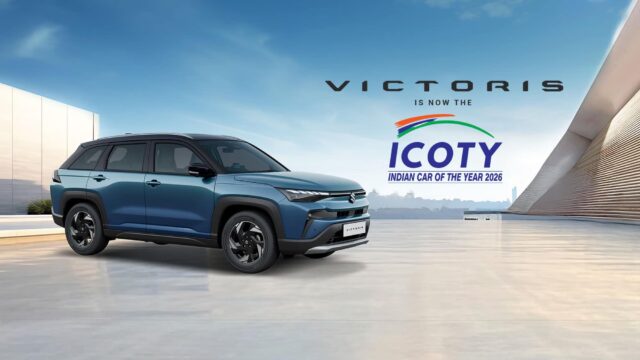
Product strategy is also playing a key role in supporting demand across segments. The company strengthened its presence in the mid-SUV category with the launch of the VICTORIS, which has quickly crossed 50,000 cumulative sales, making it the fastest model in its segment to achieve this milestone.
Its strong reception was further validated by winning the Indian Car of the Year Award. At the same time, Maruti Suzuki has taken a decisive step into electric mobility with the launch of the e VITARA, its first fully electric SUV built on a dedicated platform for both domestic and global markets. Management indicated that the initial response has been encouraging, while reiterating its commitment to a balanced multi-powertrain approach.
Exports remain a key pillar
Exports continued to provide a strong growth lever. The company maintained its leadership in overseas markets, contributing nearly half of India’s total passenger vehicle exports during the year. This diversification across geographies has helped strengthen resilience amid a complex global environment.
Navigating a challenging environment
Management acknowledged that the operating landscape remained challenging, with geopolitical tensions, supply chain disruptions and volatility in key inputs such as rare earth materials and energy. In response, the company has intensified coordination with suppliers and logistics partners, while strengthening contingency planning to ensure continuity of operations.
Record financial performance
Despite these headwinds, Maruti Suzuki delivered a record financial performance. The company posted its highest-ever annual sales at 2.42 million units, including record exports of 447,000 units. Net sales crossed ₹1.74 trillion, registering a growth of over 20%, while net profit reached an all-time high of ₹144.4 billion. The company also achieved a landmark milestone of 3 crore cumulative domestic sales, underlining its dominant position in the Indian passenger vehicle market.
Investing for the future
Alongside capacity and growth, the company is investing in future-ready initiatives. It has expanded its EV ecosystem with over 2,000 charging points across more than 1,100 cities and is working with multiple partners to scale this network significantly by 2030.
On the product side, safety continues to be a priority, with six airbags now standard in nearly the entire lineup, complemented by advanced safety systems. The company is also focusing on inclusive mobility, introducing features such as a swivel seat option in the WagonR to improve accessibility for senior citizens and persons with disabilities.
Outlook anchored in confidence
In essence, Maruti Suzuki’s strategy is clear. With demand firmly in place and a substantial order backlog to address, the company is moving decisively to remove capacity bottlenecks. As management indicated, the scale and speed of expansion signal strong confidence in the long-term growth potential of India’s passenger vehicle market, positioning the company to capture the next phase of industry expansion.