

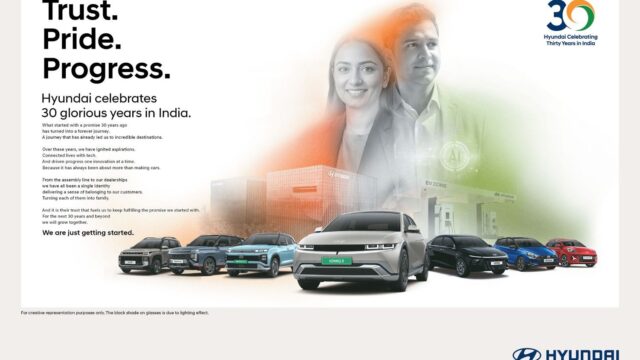
At 30, Hyundai Motor India stands young, agile and future-ready, accelerating India’s mobility journey with renewed ambition. The South Korean auto major is marking three decades in the country on the back of strong milestones and an even bolder roadmap ahead.
Since inception, Hyundai has invested ₹40,700 crore in India and is now stepping on the gas with a fresh ₹45,000 crore capex plan for FY26–FY30. The investment will power manufacturing expansion, electrification, future mobility solutions and the launch of 26 new products by FY2030.
Three decades of scale and trust
Established on May 6, 1996, Hyundai Motor India Ltd (HMIL) has evolved into one of the country’s most trusted automotive brands. The company has clocked cumulative sales of over 13.5 million units, including 9.6 million units in the domestic market and 3.9 million units exported to over 150 countries.
This performance also reinforces India’s strategic importance in Hyundai’s global playbook, with HMIL emerging as the largest passenger vehicle exporter from India on a cumulative basis.
HMIL MD & CEO Tarun Garg, said the company’s 30-year journey has been shaped by consistent delivery and customer trust, while also contributing meaningfully to India’s evolving mobility landscape.
India at the core
India continues to remain central to Hyundai’s global strategy. A deep localisation push has enabled the company to achieve an average localisation level of 82%, strengthening domestic supply chains, saving foreign exchange and supporting local industries and jobs.
Building manufacturing muscle
Hyundai’s India journey began with its integrated manufacturing facility at Sriperumbudur near Chennai in 1996, which was commissioned in 1998. This became Hyundai’s first fully integrated plant outside South Korea and has since transformed into a benchmark for smart and green manufacturing.
In line with rising demand, the company operationalised its Talegaon facility in Pune in 2025. Together, the Chennai and Talegaon plants now offer a combined annual production capacity of 9.94 lakh units, which is expected to scale up to 10.74 lakh units by 2028, cementing India’s role as a global manufacturing hub for Hyundai.
A Hyundai for every India
HMIL has built a formidable pan-India presence with over 1,500 sales outlets across more than 1,100 cities, covering nearly 78% of Indian districts. This expansive footprint enables deeper market penetration and stronger customer engagement across urban and rural markets alike.
Service as a differentiator
Customer-centricity has remained at the heart of Hyundai’s India journey. The company today operates 1,675 service touchpoints supported by 162 mobile service vans across 1,025 cities, ensuring last-mile reach.
With over 50,000 trained professionals across dealerships, Hyundai maintains a robust 91.5% Net Promoter Score. Its service ecosystem is increasingly digital, with 91% of repair orders initiated digitally, live service streaming across 632 workshops and remote diagnostics enhancing customer convenience.
Eco-conscious initiatives such as dry wash, waterborne paint systems, paperless operations across all touchpoints and solar adoption at 120 locations further underscore Hyundai’s sustainability-led service approach. Extended warranty programmes of up to seven years have also driven customer confidence, with over 3.2 million policies sold.
Make in India, made for the world
Hyundai has firmly positioned India as a global export hub. With over 3.9 million vehicles exported to 150+ countries, the company continues to champion the “Make in India, Made for the World” philosophy.
Key export markets include Saudi Arabia, South Africa, Mexico, Chile and Peru, with models such as the Hyundai Verna, Grand i10 NIOS and Aura driving volumes. Export milestones reflect steady scale-up—from 0.5 million units in 2008 to 3.9 million units in 2026.
ESG at the core
Sustainability is deeply embedded in Hyundai’s India operations. All HMIL offices and plants operate on 100% renewable energy under the RE100 initiative, aligned with Hyundai Motor Company’s global goal of achieving carbon neutrality by 2045.
Water stewardship remains a key focus, with 80% of requirements at the Chennai plant met through rainwater harvesting and recycling. Zero liquid discharge is maintained across key facilities, while over 350 energy efficiency projects have been implemented over the past five years.
Jobs and people power
Over three decades, HMIL has generated 15,000–18,000 direct jobs and supported indirect employment for up to 4.5 lakh people through its ecosystem. The company continues to be recognised among India’s top employers, with a strong focus on diversity, inclusion and future-ready talent.
In 2026, HMIL was named a ‘Top Employer’ for the third consecutive year by the Top Employers Institute, reinforcing its leadership in people practices.