


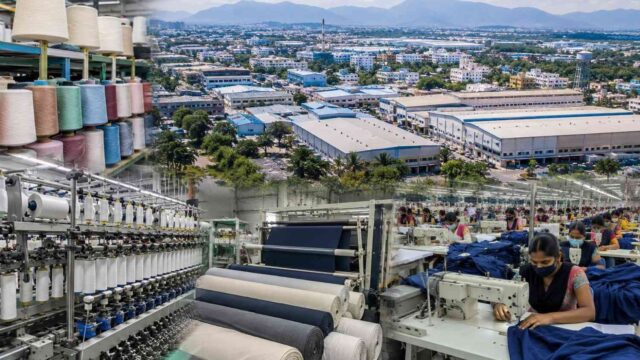
India’s textile and apparel industry is staring at a fresh crisis as sharp increases in cotton prices, rising input costs, weak domestic demand, and global geopolitical uncertainties place severe pressure across the entire value chain.
According to Kumar Duraiswamy, Joint Secretary of Tiruppur Exporters’ Association, the ongoing stress in the sector has largely remained overshadowed by political developments, even as spinning mills, garment manufacturers, and ancillary industries struggle to manage escalating costs and supply disruptions.
Cotton prices, which were around ₹54,500 per candy (355 kg) in February, have now surged to nearly ₹69,000 per candy, with industry stakeholders fearing further escalation in the coming months.
Falling cotton output worsens supply concerns
India’s cotton production is estimated to decline sharply this year to nearly 280 lakh bales from the usual 330 lakh bales, primarily due to reduced cultivation in major cotton-growing states.
However Duraiswamy, said the present crisis goes beyond short-term production issues and reflects deeper structural weaknesses in India’s cotton ecosystem.
He pointed out that countries such as the United States, Brazil, Australia, and several African nations achieve cotton yields of nearly 800 kg per hectare, while India’s productivity remains between 400 kg and 450 kg per hectare. At the same time, India’s cotton production costs remain significantly higher than competing nations, while quality and seed standards continue to lag global benchmarks.
“The production of high-grade cotton is steadily declining, and unless structural deficiencies are addressed urgently, the industry will continue to face recurring disruptions,” Duraiswamy said.
Spinning mills struggle with mounting pressure
Speculative trading and cotton hoarding have aggravated the current market volatility. He said traders have purchased large quantities of cotton released by the Cotton Corporation of India (CCI), leading to artificial scarcity and steep price increases. In just four days last week alone, cotton prices reportedly rose by ₹4,200 per candy.
The situation has left spinning mills financially strained. While large spinning groups previously maintained year-long cotton inventories, even financially strong mills are currently managing stocks sufficient for only three to four months. Smaller mills, meanwhile, are operating with barely two months of inventory.
The crisis comes at a time when spinning mills are still recovering from the impact of the pandemic and global trade disruptions. Duraiswamy said mills had continued operations despite weak demand by offering deep discounts and extended credit periods, resulting in substantial financial stress.
Export demand offers temporary relief
The recent increase in yarn exports to China has provided temporary support for spinning mills, as export buyers are offering marginally better prices along with secured payments.
“As spinning mills attempt to recover past losses, exports have become a more viable route compared to the domestic market,” Duraiswamy said, adding that spinning operations are highly capital-intensive and require sustainable returns to survive.
He warned that several mills with capacities of nearly 10 lakh spindles have already shut operations in recent years due to rising costs, labour shortages, outdated machinery, volatile demand, and inadequate policy support.
Garment sector faces rising production costs
The garment manufacturing sector is also under mounting pressure from rising yarn prices, expensive logistics, and higher costs of dyes, chemicals, synthetic fibres, and fuel, especially amid the ongoing Iran-Israel conflict and broader geopolitical instability.
Duraiswamy said garment production costs have risen by nearly 20%, but international buyers and domestic traders remain unwilling to absorb the increase.
Adding to the pressure is the growing influx of garments and fabrics from Bangladesh, which has intensified competition for domestic manufacturers.
“The disruption affects not only garment factories but also the entire ecosystem of job-work units, processing units, transporters, and ancillary industries dependent on the apparel sector,” said Duraiswamy.
Industry seeks urgent policy intervention
The industry has urged the Central Government to immediately ensure that cotton sold by CCI reaches only genuine spinning mills directly instead of traders.
Kumar Duraiswamy also called for easier procurement norms, low-interest cotton supply mechanisms for mills, and removal of the existing 11% import duty on cotton for at least five years to bridge the widening gap between domestic demand and supply.
At the same time, he welcomed the Union Cabinet’s approval of ₹5,400 crore under the National Cotton Mission, saying the initiative could significantly improve productivity, quality, and cost competitiveness over the next five years.
“The textile industry is fully prepared to support India’s ambition of becoming a $40 billion apparel manufacturing hub by 2030. But without strong and timely policy support, the sector’s growth potential may remain unrealised,” said Duraiswamy.