


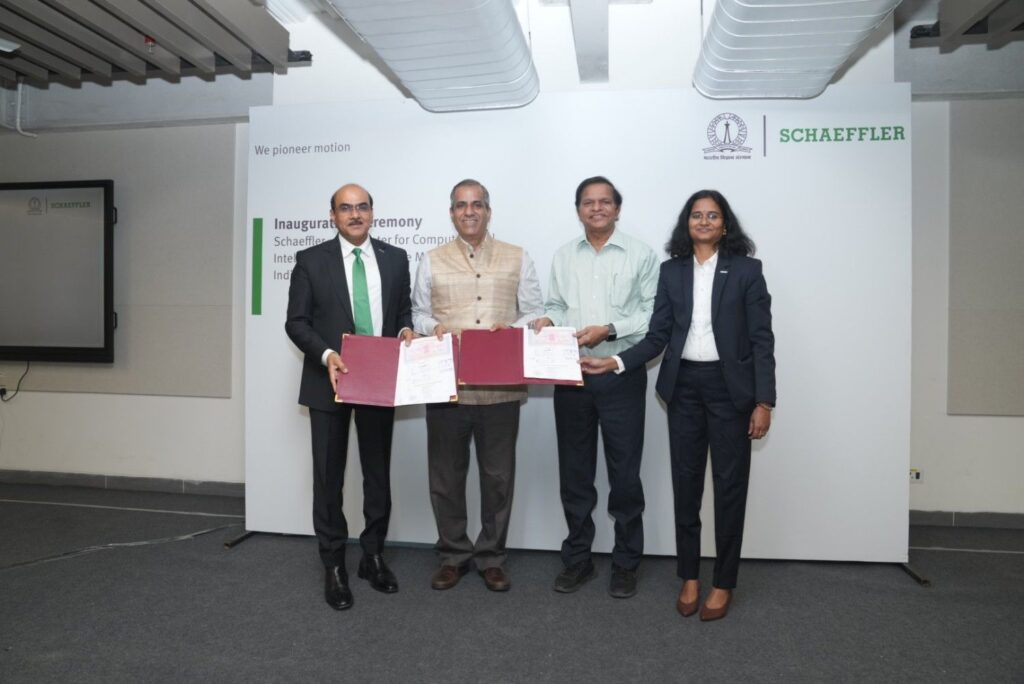
Motion technology company Schaeffler India has expanded its research-led innovation push with the launch of a new computational research infrastructure at the Foundation for Science Innovation and Development (FSID), Bengaluru, strengthening its collaboration with the Indian Institute of Science ecosystem.
The facility has been designed to enhance high-performance computing (HPC) capabilities and support large-scale simulations, advanced analytics and data-intensive modelling across materials science, energy systems and sustainable mobility.
Building next-generation computational capabilities
As part of the initiative, Schaeffler India has supported the expansion of FSID’s digital infrastructure through dedicated laboratory space, advanced in-rack cooling systems, power backup solutions and high-performance hybrid computing workstations and clusters.
The company said the upgraded infrastructure would improve computational efficiency, accelerate advanced research programmes and foster stronger collaboration between academia and industry.
Research collaboration pipeline gains momentum
In another significant development, Schaeffler India has signed a Master Research Agreement (MRA) with IISc, laying the groundwork for multiple future collaborative research projects.
Schaeffler India Managing Director and Chief Executive Officer Harsha Kadam said industry-academia partnerships would play a critical role in building India’s long-term manufacturing and research excellence.
Facility could scale to 32 PFLOPs
IISc Associate Professor of Materials Engineering Sai Gautam Gopalakrishnan described the initiative as a major step towards developing intelligent and sustainable systems research infrastructure.
According to him, the long-term vision is to create a computational facility with peak performance of nearly 32 PFLOPs using a combination of CPUs and GPUs.
Driving industry-relevant innovation
FSID Director Prof B. Gurumoorthy said the partnership would significantly strengthen the institute’s ability to support interdisciplinary research and next-generation technology development.
He noted that the collaboration reflects how industry and academia can work together to accelerate innovation with real-world relevance across engineering and deep-science domains.
By strengthening FSID’s computational infrastructure, Schaeffler India aims to catalyse agile research, support advanced engineering applications and help develop industry-ready scientific solutions for the futur