


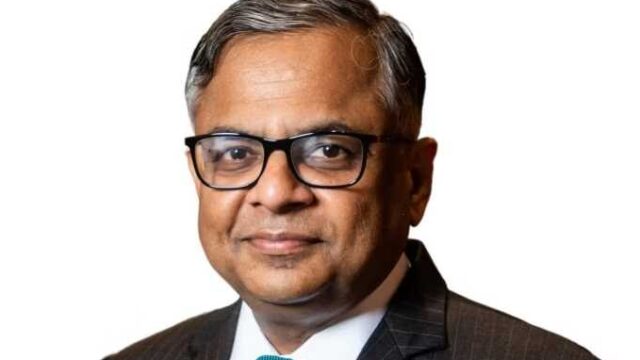
India’s largest IT services company Tata Consultancy Services (TCS) is accelerating its transition into an AI and digital transformation-led enterprise, with Chairman N Chandrasekaran outlining an aggressive artificial intelligence strategy in the company’s latest annual report.
Chandrasekaran said AI is emerging as a foundational technology reshaping industries through automation and enterprise transformation, prompting TCS to reposition itself as an “AI and Digital transformation partner” for global clients.
AI revenues gather pace
The company said it scaled up execution of its ‘Human+AI’ operating model and industry-specific agent marketplace during fiscal 2026.
According to the chairman’s letter to shareholders, TCS generated annualised revenues of $2.3 billion from AI services and $11.5 billion from new-age offerings spanning cloud, data, enterprise solutions and cyber security.
The company said generative AI and agentic AI are now moving beyond pilot projects to large-scale deployment, with enterprises increasingly embedding AI into core business functions.
HyperVault launch
During the year, TCS launched HyperVault, a secure-by-design AI infrastructure platform developed in partnership with TPG and backed by a broader technology ecosystem.
Chandrasekaran said India is emerging as a strategic “+1” destination for AI infrastructure amid growing global constraints around power, compute capacity and geography.
“HyperVault positions us at the centre of this shift,” he noted in the annual report.
Inorganic growth strategy
TCS also intensified its inorganic expansion strategy to strengthen next-generation capabilities in AI, cloud and SaaS technologies.
The company completed the acquisitions of Coastal Cloud for US$ 700 million in December 2025 and ListEngage in October 2025.
According to TCS, the acquisitions are expected to strengthen its Salesforce practice and enhance agentic AI capabilities.
AI-led customer engagements
The company highlighted multiple AI-led transformation projects executed globally during the year.
TCS said it modernised a mission-critical crew management system for a European airline using generative AI, rebuilt legacy systems for enterprise applications, and deployed AI-driven dispatch optimisation for a leading US utility company, improving field efficiency by 30%.
The company also said Physical AI applications are helping improve safety and productivity for an electronics manufacturer.
Building AI operating systems
Chandrasekaran said trust, security and data sovereignty will become critical as enterprises scale AI deployments.
He noted that enterprises would increasingly require a dedicated AI Operating System integrating infrastructure, data, models, governance, context and intelligent agents.
Looking ahead, TCS said it will focus on building AI operating systems for industries, constructing India’s first AI-focused data centre with rack density exceeding 160 KW, strengthening partnerships with hyperscalers and frontier AI firms, and creating secure sovereign AI infrastructure.
Sustainability and social impact
The chairman said sustainability continues to remain integral to TCS’ long-term strategy under the Tata Group’s Project Aalingana initiative.
TCS said nearly 79% of its global energy consumption during fiscal 2026 came from renewable sources.
The company also highlighted its social impact initiatives, stating that over 18.13 million people globally benefited from programmes in education, healthcare, skills and environmental sustainability during the year.
According to the annual report, TCS employees volunteered 9.42 million hours, impacting nearly 12.96 million lives worldwide.