


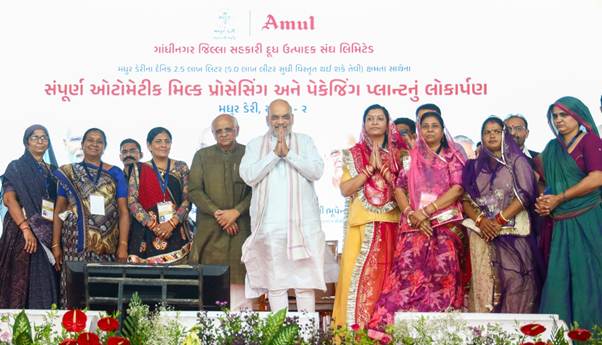
The inauguration of Madhur Dairy’s fully automated milk processing and packaging plant in Gujarat marks more than just a capacity expansion for the dairy cooperative sector. It underlines how India’s dairy ecosystem is increasingly evolving into a technology-led rural economic engine driven by women participation, value-added products and cooperative-led wealth creation.
Union Home and Cooperation Minister Amit Shah inaugurated Madhur Dairy Unit-2 at Dashela in Gandhinagar, describing the project as a major step toward empowering lakhs of milk-producing families across rural India.
Spread across 15 acres and built at an investment of nearly ₹128 crore, the new facility currently has the capacity to process 2.5 lakh litres of milk per day, with plans to scale it up to 5 lakh litres daily in the coming years.
From small cooperative to ₹628 crore dairy network
Madhur Dairy’s growth story reflects the transformation of India’s cooperative dairy movement over the past five decades.
Starting operations in 1971 with milk collection of just 6,000 litres and a turnover of ₹7,000, the dairy has now evolved into a ₹628 crore enterprise with a large procurement, processing and distribution network across Gujarat.
The expansion comes at a time when dairy cooperatives are increasingly investing in automation, modern packaging systems and high-margin nutritional products to strengthen farmer incomes and compete in India’s rapidly evolving food and beverage sector.
Amit Shah said a significant portion of the profits generated through the new project would directly flow into the bank accounts of milk producers, reinforcing the cooperative model’s role in strengthening rural economies.
Women emerge as the backbone of India’s dairy economy
The new dairy facility also highlights the growing role of women in India’s rural economic transformation.
According to Shah, nearly 36 lakh women are currently associated with milk production networks generating around 3 crore litres of milk every day. Through the cooperative dairy ecosystem, nearly ₹200 crore is being directly transferred daily into their bank accounts.
He said the dairy movement has transformed women from being limited to household responsibilities into active economic contributors within rural families.
The cooperative dairy structure, particularly in Gujarat, has become a large-scale vehicle for women empowerment, financial inclusion and self-reliance in villages.
Technology and value-added products drive next growth phase
India’s leading cooperative dairies are increasingly moving beyond conventional milk sales into high-value nutrition and wellness products.
Shah noted that leading dairy cooperatives such as Amul, Banas Dairy and Mehsana Dairy are investing heavily in advanced technologies and value-added offerings including protein shakes, probiotic curd and high-protein beverages.
The strategy reflects a broader shift in India’s dairy industry, where cooperatives are attempting to capture higher consumer spending in the nutrition and health categories while ensuring profits are distributed back to livestock farmers.
Circular economy may reshape dairy incomes
The government also sees sustainability and circular economy practices becoming the next major driver for dairy sector profitability.
Amit Shah said the adoption of circular economy principles across dairy operations could increase farmer incomes by at least 20% in the coming years.
With India already the world’s largest milk producer, policymakers are now focusing on improving productivity, value addition and supply-chain efficiencies rather than only increasing output.
The Madhur Dairy expansion reflects this broader transition — from traditional milk collection systems toward a technology-enabled, value-added and farmer-centric dairy economy capable of delivering stronger rural incomes and long-term sustainability