


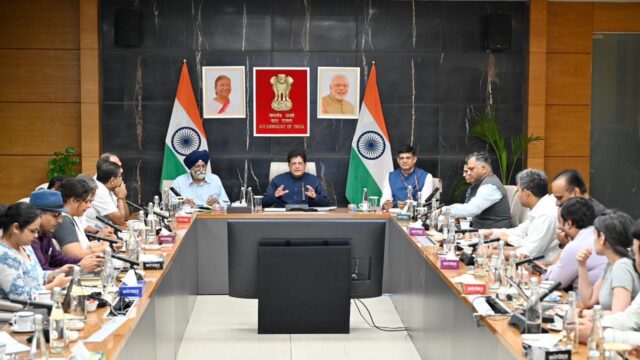
The Department for Promotion of Industry and Internal Trade (DPIIT) has unveiled detailed operational guidelines for the implementation of the BHAVYA Scheme, a large-scale industrial infrastructure initiative aimed at creating investment-ready manufacturing ecosystems across India.
The Central Sector Scheme is positioned as a major building block in India’s broader manufacturing and logistics transformation strategy, aligning with flagship initiatives such as Make in India and PM Gati Shakti.
Focus shifts from land allocation to integrated industrial ecosystems
Unlike traditional industrial estate models that primarily focused on land allocation, the BHAVYA Scheme seeks to create fully integrated industrial parks equipped with plug-and-play infrastructure, logistics connectivity, worker-support facilities and digital governance systems.
The scheme proposes development of 100 industrial parks over six years between 2026-27 and 2031-32, with a total financial outlay of around ₹33,660 crore.
In the first phase, up to 50 industrial parks will be selected through a challenge-based competitive process, indicating the government’s attempt to prioritise quality and execution readiness over broad-based allocation.
The emphasis on “investment-ready” infrastructure reflects a growing policy recognition that global manufacturers increasingly evaluate ecosystems rather than standalone incentives while choosing investment destinations.
Plug-and-play infrastructure becomes central strategy
A key differentiator of the BHAVYA framework is its focus on globally benchmarked industrial infrastructure standards.
The guidelines provide for integrated utility systems, multimodal logistics connectivity, renewable energy infrastructure, worker housing, testing laboratories, digital single-window systems and common effluent treatment facilities.
The push for underground utility systems, digital governance readiness and sustainable infrastructure indicates India is attempting to address long-standing concerns around industrial infrastructure quality and operational efficiency.
The inclusion of worker-support infrastructure also signals a broader shift towards creating manufacturing clusters capable of supporting large-scale employment generation and long-term industrial ecosystems.
Competitive selection process could improve project quality
The challenge-based selection framework is likely to become one of the most closely watched aspects of the scheme.
Industrial park proposals will be evaluated on objective criteria including multimodal connectivity, site suitability, ecosystem strength, sustainability measures and infrastructure quality.
This model could help prevent the creation of underutilised industrial parks that have historically emerged due to weak planning, inadequate connectivity or poor ecosystem integration.
The framework also creates competitive pressure among states and developers to offer stronger industrial propositions backed by policy facilitation and execution capabilities.
Large-scale manufacturing and supply chain integration in focus
The BHAVYA Scheme appears designed to support India’s larger ambition of becoming a global manufacturing and supply chain hub amid ongoing geopolitical diversification strategies by multinational companies.
By allowing industrial parks up to 1,000 acres and integrating logistics, utilities, skilling and sustainability components, the government is attempting to create infrastructure capable of attracting large anchor manufacturing investments.
The convergence provisions with central and state-level logistics, renewable energy and skilling initiatives further strengthen the integrated development approach.
The timing is significant as India continues to position itself as an alternative manufacturing destination within global value chains across sectors such as electronics, automobiles, renewable energy equipment and advanced manufacturing.
SPV-led model aims to improve accountability
Project implementation under the scheme will be carried out through Special Purpose Vehicles (SPVs) incorporated under the Companies Act, 2013.
The SPVs will oversee planning, development, investor facilitation, operations and long-term asset maintenance, creating a more structured governance framework compared to traditional industrial infrastructure models.
The National Industrial Corridor Development Corporation (NICDC) has been designated as the Project Management Agency for implementation and monitoring.
The guidelines also open the door for participation by private developers through project-specific SPVs, signalling the government’s intent to combine public sector policy support with private sector execution expertise.
GIS monitoring and transparency mechanisms added
To improve transparency and project oversight, the scheme incorporates GIS-based monitoring systems, audit mechanisms and periodic progress reporting.
Oversight will be carried out by a National Level Steering Committee chaired by the Secretary, DPIIT.
These mechanisms are expected to reduce execution delays and improve monitoring of large infrastructure projects, which have historically faced timeline and coordination challenges.
The release of the operational guidelines marks the formal groundwork for one of India’s most ambitious industrial infrastructure programmes, with the success of BHAVYA likely to play a critical role in determining how effectively India scales its manufacturing ecosystem over the next decade.