


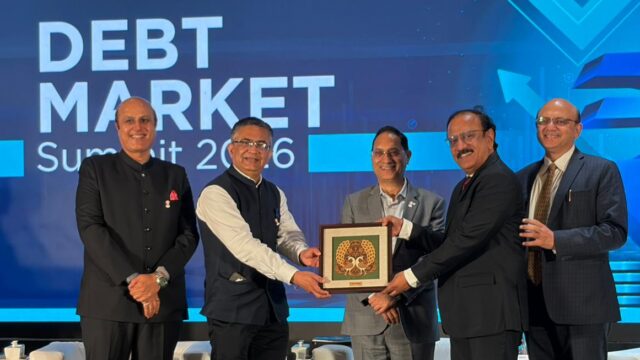
India’s corporate debt market will play a pivotal role in supporting the country’s long-term economic growth ambitions, according to of Securities and Exchange Board of India (SEBI) Chairman Tuhin Kanta Pandey.
Addressing the CareEdge Conversation ‘Debt Market Summit’ in Mumbai, Pandey said a growing economy requires patient debt capital to fund infrastructure, capacity expansion, refinancing and long-gestation projects, while also enabling broader access to global capital providers.
Bond market emerging as second engine of growth
Pandey said the corporate bond market is increasingly becoming the economy’s “second engine of growth,” helping reduce over-reliance on the banking system.
He noted that a deeper bond market can support financing for infrastructure, productive capacity, urbanisation, energy transition, housing and digital infrastructure.
India’s outstanding corporate bonds have grown from about Rs 17.5 lakh crore at the end of FY16 to more than Rs 59 lakh crore currently, reflecting a CAGR of nearly 12%.
In FY26, debt issuers mobilised nearly Rs 9.1 trillion, almost double the amount raised through equity issuances.
However, Pandey pointed out that despite nearly 6,000 companies being listed on the NSE and BSE, only 776 companies currently have listed debt instruments. “We need more issuers to see the debt market as a regular source of capital,” he said.
Retail participation in bonds remains low
Highlighting the need to deepen retail participation, Tuhin Kanta Pandey said that while retail investors have actively embraced equities and mutual funds, corporate bonds continue to remain unfamiliar to most Indian households.
Citing a SEBI investor survey, he said awareness of corporate bonds stands at just 10%, while household penetration remains below 1%.
He stressed the need for simpler access mechanisms, better disclosures, improved fixed-income liquidity and more investor-friendly communication around bond investments.
SEBI exploring reforms and tokenisation pilot
Pandey said SEBI is working with market participants, the Reserve Bank of India (RBI) and the Ministry of Finance on a market-making framework announced in the Union Budget.
The regulator is also exploring a separate regulatory classification for debt brokers to reduce costs and encourage specialised debt market intermediaries.
Additionally, SEBI is evaluating a pilot project for tokenisation of corporate bonds aimed at enabling faster settlement, improved traceability, automated servicing and enhanced transparency.
He added that the municipal debt framework is also under review to support pooled financing for municipal bodies and encourage greater retail participation in municipal bonds.
“The future of India’s bond market lies in a broad network of reforms spanning market-making, municipal bonds, securitisation, bond indices and derivatives, tokenisation and investor education,” Pandey said.
Corporate bonds must play bigger role: NSE CEO
National Stock Exchange MD & CEO Ashishkumar Chauhan said India’s ambition of becoming a developed nation by 2047 would require investments to rise from around 30% of GDP to over 35%.
“Bank credit alone cannot carry that burden, and therefore corporate bonds must play a much larger role,” he said.
Chauhan noted that India’s bond market size currently stands at 17.1% of GDP, significantly lower than South Korea’s 75.7%, Malaysia’s 54.7% and the United States’ 38.2%.
Corporate bonds currently account for 13.5% of India’s domestic debt market.
He also highlighted the sharp rise in trading activity, with average daily trading volumes in corporate bonds reaching Rs 9,168 crore in FY26, nearly three times higher than Rs 3,180 crore recorded in FY25.
Debt market key to financing India’s future
India’s corporate bond market has expanded steadily over the years, though it remains relatively small compared with global markets such as the US and China.
Challenges including dependence on bank credit, preference for private placements, limited foreign participation, liquidity constraints, regulatory restrictions and tax-related issues continue to impact the sector.
Several initiatives aimed at simplifying regulations, strengthening the credit default swap market and supporting the market during periods of financial stress have been undertaken to deepen the bond market ecosystem.
CareEdge MD & Group CEO Mehul Pandya said, “A nation of 1.4 billion people, the fastest growing major economy in the world, a vision of becoming a $30 trillion economy by 2047, that is the acceleration of Viksit Bharat. And standing within that ambition and its realisation, is a single critical question, how does India finance its future? The answer lies in large part right here in the debt market.”