


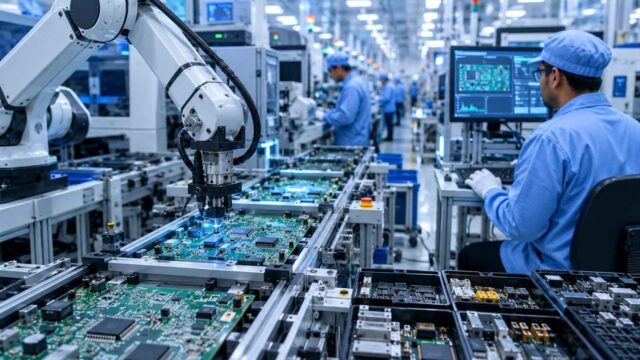
India’s electronic manufacturing services (EMS) industry is at a strategic turning point, having achieved significant scale over the past five years but still facing challenges in moving up the value chain, according to a new report by KPMG in India.
Market expected to cross $150 billion by FY30
The report, titled India’s Electronic Manufacturing Services (EMS) Opportunity: From Assembly Hub to Integrated Manufacturing Powerhouse, highlights how global electronics supply chains are undergoing a major transformation driven by geopolitical shifts, resilience priorities and increasing technological complexity, creating a significant opportunity for India.
According to the report, India’s EMS market has expanded from approximately $10–12 billion in FY20 to $40–45 billion in FY25 and is projected to surpass $150 billion by FY30. The growth is being fuelled by strong domestic demand, government policy support and global manufacturers’ China+1 diversification strategies.
Scale without depth challenge persists
However, the report notes that the sector is grappling with a “scale without depth” paradox. While India has emerged as a major assembly hub, particularly for mobile phones and consumer electronics, its presence in higher-value activities such as product design, component manufacturing and intellectual property ownership remains limited.
Building capabilities beyond assembly
“India’s EMS sector has reached a pivotal moment where the foundations of scale are firmly in place, but the next phase of growth will be defined by depth,” KPMG India Partner Automotive & Lead, Electric Mobility, Rohan Rao, said.
He added that as global supply chains increasingly move toward resilient and multi-node manufacturing networks, India has a time-bound opportunity to evolve beyond assembly-led growth and build integrated, design-driven capabilities. Achieving this, he said, will require sustained investments in component ecosystems, engineering expertise and supply-chain sophistication.
Global EMS industry set for trillion-dollar expansion
The report estimates the global EMS market at $640–650 billion in 2025 and expects it to exceed $1 trillion in the early 2030s, supported by trends such as connectivity, electrification and increased outsourcing by original equipment manufacturers (OEMs).
India currently accounts for around 5–6 per cent of global EMS manufacturing, indicating substantial room for expansion. Yet, the industry remains heavily dependent on imports, with 80–95% of critical electronic components sourced from overseas. This dependency continues to constrain domestic value addition and profitability.
Higher-complexity segments offer long-term value
The report also highlights the importance of strategic segment prioritisation. While consumer electronics will continue to drive scale, higher-complexity sectors such as automotive, industrial electronics, aerospace and defence are expected to generate greater long-term value due to their engineering intensity, certification requirements and higher barriers to entry.
“The trajectory of India’s EMS industry will be determined not just by how much capacity it builds, but by where it chooses to compete,” said KPMG India Partner, M&A Consulting, Raghavan Viswanathan.
He noted that the transition from capacity-led growth to capability-led growth would be essential for India to emerge as a globally competitive electronics manufacturing hub.
Policy support and localisation remain critical
The report further points out that government support has been a major catalyst for growth, with cumulative incentives of about $19.5 billion aimed at strengthening the electronics manufacturing ecosystem. However, maintaining competitiveness in the coming years will depend on greater localisation, stronger design capabilities, deeper certification expertise and increased integration across the value chain.
A decisive decade ahead
KPMG said the next five to ten years will be crucial in determining whether India remains primarily an assembly destination or evolves into a globally competitive electronics ecosystem with advanced component manufacturing and design-led innovation capabilities.