


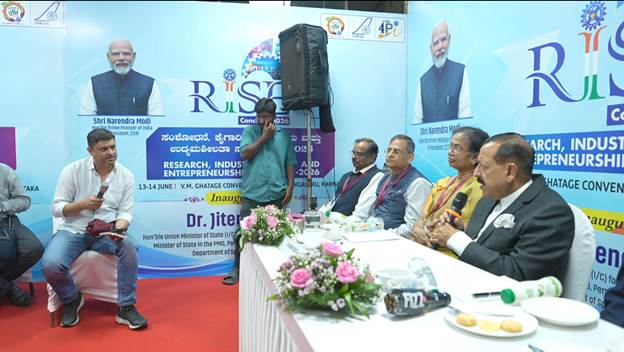
India’s space economy is poised for a significant expansion, with its value expected to rise from the current $8-9 billion to nearly $40-45 billion over the next decade, driven by policy reforms, growing private sector participation and a rapidly evolving innovation ecosystem, Union Minister of State (Independent Charge) for Science and Technology Dr. Jitendra Singh said.
Addressing a press conference in Bengaluru, Singh said the transformation of India’s space sector mirrors a broader shift underway across the country, where science and technology are no longer confined to laboratories but have become integral to the national consciousness.
Science becoming a people’s movement
According to the minister, one of the most notable achievements in recent years has been the growing connection between science and society, with citizens increasingly viewing themselves as active stakeholders in the country’s scientific progress.
“The biggest achievement is that the common citizen today feels connected to India’s scientific progress and sees a stake in it,” Singh said.
He noted that the increasing presence of mainstream media at science and technology events reflects rising public interest in scientific developments. Missions such as Chandrayaan-3 have helped transform space science into a subject of widespread public engagement and national pride, he added.
Space reforms fuel startup growth
Highlighting the impact of policy reforms in the space sector, Singh said India has witnessed remarkable growth in private participation.
From having only a handful of space startups a few years ago, the country today hosts more than 400 space startups that are contributing to a vibrant and rapidly expanding ecosystem.
He said the pace of growth achieved within a short period underscores the immense potential of India’s space economy and reflects the success of reforms aimed at opening the sector to private players.
India strengthens position among leading space nations
Singh said landmark missions such as Chandrayaan-3 and the upcoming Gaganyaan human spaceflight programme have strengthened India’s standing among the world’s leading space-faring nations.
India has consistently demonstrated its ability to execute complex missions with innovation, efficiency and cost-effectiveness, enhancing global confidence in the country’s technological capabilities, he added.
The minister noted that achievements in frontier sectors including space, atomic energy and advanced technologies have boosted India’s international reputation and reinforced trust in indigenous technologies.
Space technology driving governance and development
One of India’s distinctive strengths, Singh said, lies in its extensive use of space technology for governance and developmental initiatives.
He pointed out that space-based applications have been integrated into infrastructure planning, project monitoring and public service delivery on a scale rarely seen globally.
Programmes such as PM Gati Shakti, urban development initiatives and drone-enabled monitoring systems are helping improve planning, implementation and oversight of development projects while enhancing efficiency and transparency.
PSLV anomaly findings identified
On the recent PSLV mission anomaly, Singh said the analysis has been completed and the underlying causes have been identified.
Corrective measures have already been initiated and future missions will benefit from the lessons learned, further strengthening India’s space programme, he added.
Innovation ecosystem to support Viksit Bharat vision
Singh said India’s scientific achievements are increasingly contributing to economic growth, technological self-reliance and global competitiveness.
The growing participation of startups, industry and research institutions is creating a robust innovation ecosystem capable of supporting the country’s vision of Viksit Bharat 2047.
As India accelerates its journey in emerging technology domains, the expanding space economy is expected to emerge as a key driver of innovation, investment and long-term economic growth, he added.