


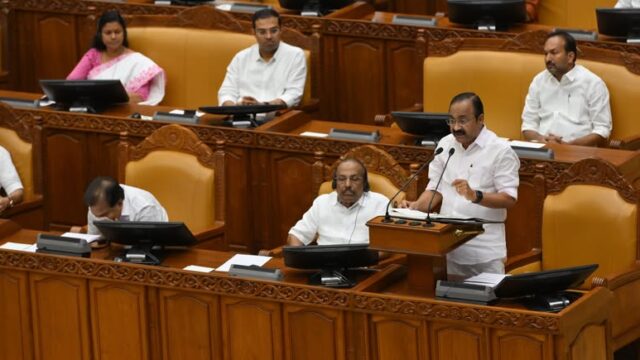
The Kerala government has unveiled an ambitious development agenda in the Revised Budget 2026-27, combining large-scale infrastructure projects, investment promotion measures and welfare initiatives despite mounting fiscal pressures.
Presenting the budget, Chief Minister V D Satheesan, who also holds the finance portfolio, outlined a vision to transform Kerala into an investment-driven economy while retaining its commitment to social welfare and inclusive growth.
Fiscal challenges remain significant
The government acknowledged the state’s difficult financial position, citing a debt burden exceeding ₹5 lakh crore, substantial committed expenditure on salaries, pensions and interest payments, and accumulated liabilities of over ₹87,000 crore.
Against this backdrop, the Plan Outlay for 2026-27 has been revised downward to ₹30,370 crore from ₹35,750 crore estimated in the previous budget.
Mission Samudra to drive maritime economy
A key highlight of the budget is Mission Samudra, a comprehensive maritime development programme aimed at leveraging Kerala’s extensive coastline, ports and waterways.
The initiative seeks to integrate ports, logistics infrastructure, manufacturing clusters and inland waterways to create a modern maritime economy. An allocation of ₹400 crore has been earmarked for the programme.
Economic corridors and industrial growth
The government has proposed the Southern Kerala Economic Corridor connecting Thiruvananthapuram, Kollam and Alappuzha as a major growth zone. A Rare Earth and Critical Minerals Corridor is also planned to support strategic industries and mineral processing activities.
To improve investor confidence, the government will establish Invest Keralam, a dedicated investment facilitation mechanism aimed at providing faster approvals and streamlined project implementation.
A Special Investment Zone with world-class infrastructure and simplified clearances is also proposed to attract large investors in manufacturing, logistics, technology and renewable energy.
Focus on MSMEs and entrepreneurship
Recognising the role of small businesses in employment generation, the government announced the Kerala MSME Growth Scheme with a target of creating 10,000 new enterprises.
The scheme will provide financial assistance, technology support, market access and mentorship to entrepreneurs. Existing incubation centres will also be strengthened to support startups and innovation-driven businesses.
Jobs and future-ready skills
The budget places strong emphasis on employment creation and future technologies.
A Global Job Watch Tower will be established to monitor global employment trends and align education and skill development programmes with emerging opportunities.
Kerala also plans to strengthen its participation in sectors such as Artificial Intelligence, robotics, data science, IoT, biotechnology and space technology.
A dedicated Gen-Z technology initiative has received an allocation of ₹50 crore, while ₹10 crore has been earmarked for developing Malayalam AI datasets and language models.
Education and research ecosystem
The government aims to position Kerala as a global knowledge hub through investments in higher education, research and innovation.
Major proposals include the Kerala Knowledge Valley, Health and Life Sciences City, Research Parks and the Kerala School of Planning, Architecture and Design.
Higher education reforms will focus on employability, research excellence and internationalisation. The budget also proposes reviving the “Semester in Kerala” programme to attract foreign students.
Urban development and mobility
Rapid urbanisation has prompted the launch of the Kerala Urban Growth Mission with an allocation of ₹100 crore.
The mission will support sustainable urban planning, economic corridors, public transport modernisation, scientific waste management and green city development.
The government has also allocated ₹20 crore for preparatory activities related to the Thiruvananthapuram and Kozhikode Light Metro projects.
Welfare measures receive a boost
The budget continues the government’s welfare focus through several major initiatives.
An allocation of ₹600 crore has been made for free bus travel for women and transgender persons in ordinary KSRTC services.
Monthly honorariums for ASHA workers have been increased from ₹9,000 to ₹12,000, while Anganwadi workers, pre-primary teachers and school meal cooks will receive a ₹1,000 monthly increase.
The proposed Oommen Chandy Health Insurance Scheme will provide health coverage of up to ₹25 lakh for families, with ₹10 crore allocated for initial implementation.
Agriculture and fisheries remain priorities
The agriculture and allied sectors have received an allocation of ₹1,534.98 crore.
The support price under the Rubber Production Incentive Scheme will be increased from ₹200 to ₹250 per kilogram. The government will also promote AI-enabled farming, women-led agricultural enterprises, farm tourism and climate-resilient agriculture.
For the fisheries sector, a dedicated Fisheries Sub-Plan has been proposed to address challenges arising from declining fish availability, climate change and rising operational costs.
Additional support will include housing schemes, educational assistance, rescue infrastructure, self-employment initiatives and coastal protection measures.
Tourism, culture and creative industries
Tourism has received an allocation of ₹325.36 crore, with the government proposing to accord industry status to the sector.
Focus areas include eco-tourism, biodiversity tourism, farm tourism, rural experiential tourism and community-based tourism initiatives. Smart tourism platforms powered by AI will also be developed.
The budget further proposes a J.C. Daniel International Film City in Kochi, a Cultural Park named after M.T. Vasudevan Nair in Kozhikode and a Johnson Music Academy in Thrissur.
Healthcare and sports infrastructure
The medical care and public health sector has been allocated ₹2,076.02 crore.
The government plans to improve infrastructure and staffing at medical colleges in Kasaragod, Idukki, Wayanad and Manjeri, operationalise a second medical college in Thiruvananthapuram and establish a new medical college in Haripad.
In sports, a world-class football stadium will be developed in the Malabar region with an allocation of ₹50 crore. The government will also implement Vision 2036 to identify and train athletes capable of competing at future Olympic Games.
Building a new growth model
Overall, the Revised Budget 2026-27 seeks to move Kerala from a remittance-led economy towards an investment-driven growth model.
Through a combination of infrastructure development, industrial expansion, technology adoption, education reforms and welfare interventions, the government aims to create a more competitive, resilient and future-ready Kerala economy.