


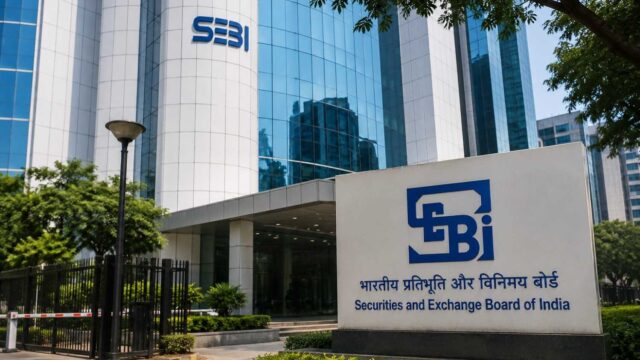
The Securities and Exchange Board of India (SEBI) has approved a series of regulatory reforms aimed at improving investor convenience, strengthening market efficiency, enhancing ease of doing business and deepening India’s capital markets.
At its 214th Board meeting held in Mumbai on June 19, SEBI cleared measures spanning securities transmission, share buybacks, mutual funds, alternative investment funds (AIFs), municipal bonds and securitisation markets.
Faster transmission of securities for heirs
SEBI approved a simplified and standardised framework for transmission of securities to legal heirs and claimants of deceased investors.
A new Quick Transmission Processing (QTP) category has been introduced for small-value claims of up to ₹10,000 for physical holdings and ₹30,000 for dematerialised holdings. Documentation requirements for larger claims have also been eased, with eligibility limits for simplified procedures doubled.
The regulator has removed mandatory PAN submission requirements in certain cases, permitted combined affidavit-cum-No Objection Certificates and accepted QR-code-enabled death certificates for verification, reducing procedural hurdles for claimants.
Open market buybacks return
In a significant move, SEBI approved the reintroduction of open market share buybacks through stock exchanges from August 1, 2026.
The regulator said the revised framework will provide companies with an additional route for buybacks while enhancing investor protection. Buybacks through stock exchanges will have to be completed within 66 working days, with at least 40% of earmarked funds deployed during the first half of the buyback period.
SEBI has also made merchant banker appointments optional for buybacks, a move aimed at reducing compliance costs and improving ease of doing business.
Mutual funds get intraday borrowing flexibility
The Board approved amendments allowing mutual funds to undertake intraday borrowings to manage temporary liquidity mismatches arising from settlement cycles, forex transactions and derivative margin obligations.
SEBI clarified that such borrowings must be repaid on the same day and cannot be used as a source of leverage. Asset management companies will be required to maintain documentation and board-approved policies governing the facility.
GARUDA mechanism to accelerate AIF launches
To speed up capital deployment by Alternative Investment Funds, SEBI approved the Green-Channel: AIF Rollout Upon Document Acknowledgement (GARUDA) mechanism.
The new framework reduces the timeline for launching regular AIF schemes to 10 working days. Certain investor-focused schemes, including Accredited Investor-only funds and Angel Funds, will be allowed to launch immediately after registration or filing of placement documents.
The move is expected to significantly shorten fund launch timelines and improve operational efficiency in the alternative investments segment.
Social Stock Exchange fund management transferred
SEBI approved the transfer of funds, administration and management of the Capacity Building Fund for the Social Stock Exchange ecosystem from NABARD to the newly incorporated Social Stock Exchange-Capacity Building Foundation, a Section 8 company.
The transition is intended to strengthen capacity-building initiatives and ecosystem development for social enterprises and market participants.
Securitisation market framework aligned with RBI norms
The Board approved amendments to securitised debt regulations to align SEBI’s framework with the Reserve Bank of India’s securitisation norms.
Key changes include permitting single-asset securitisation by RBI-regulated entities, shifting certain disclosure responsibilities to servicers, clarifying governance requirements and empowering SEBI to appoint replacement trustees when necessary.
The amendments are expected to support the development of India’s listed securitisation market while preserving investor safeguards.
Municipal bond market gets a boost
SEBI also approved amendments to municipal debt regulations aimed at expanding the municipal bond market.
Municipalities will now be allowed to raise funds for refinancing existing project debt. The regulator has also introduced measures to encourage retail participation, including lower investment denominations and incentives for select investor categories.
Additionally, compliance timelines for municipal issuers have been relaxed to account for operational complexities faced by local bodies.
SME fundraising framework to be reviewed
The Board approved a proposal to undertake an evidence-based assessment of the regulatory framework governing SME capital raising in securities markets.
The review will be carried out as part of a broader initiative to evaluate the effectiveness of existing regulations and strengthen regulatory responsiveness.
New code of conduct for SEBI members
SEBI also approved a new Code of Conduct for its Board members and amendments to employee service regulations, following recommendations made by a High-Level Committee on conflict of interest and disclosure norms.
The revised framework is aimed at enhancing governance standards, transparency and accountability within the market regulator.