


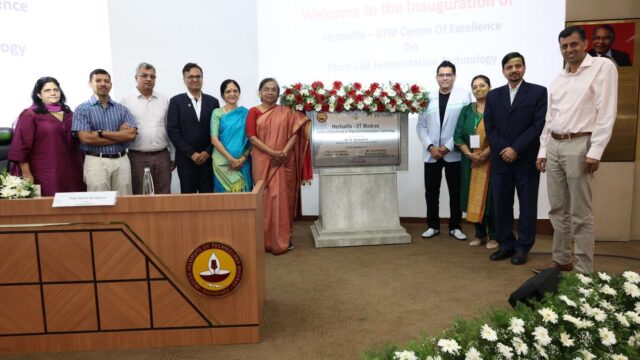
Indian Institute of Technology Madras (IIT Madras), in collaboration with Herbalife International India Pvt Ltd, has inaugurated the Herbalife–IIT Madras Centre of Excellence (CoE) on Plant Cell Fermentation Technology, India’s first dedicated facility for translational research and innovation in plant cell fermentation.
The initiative, launched on June 22, 2026, marks a significant step towards strengthening India’s capabilities in sustainable biomanufacturing and developing next-generation plant-derived health and wellness products.
National hub for innovation
The Herbalife–IIT Madras CoE is envisioned as a national hub for sustainable innovation, R&D and translational research in plant cell fermentation technology.
The Centre aims to enable sustainable and scalable production of herbal biomass, develop enriched herbal extracts and high-value phytochemicals, and bridge the gap between laboratory discoveries and industrial applications.
By integrating advanced upstream cultivation systems with state-of-the-art downstream processing and metabolomics platforms, the Centre seeks to promote technology transfer, foster innovation and entrepreneurship, and build skilled manpower in this emerging domain.
Through industry partnerships, blue-sky research, training programmes and entrepreneurial spin-offs, the initiative aims to position India prominently on the global map of commercial plant cell fermentation while contributing to the national visions of BioE3, Atmanirbhar Bharat and environmentally sustainable biomanufacturing.
Building assets for nation
IIT Madras, Dean (Alumni and Corporate Relations), Prof. Ashwin Mahalingam said, “IIT Madras partnership with Herbalife and the establishment of Centre of Excellence on plant cell fermentation is an exemplar of how industry and academia can work together to build enduring assets for the nation.
“With the high-end research facilities at the Centre, we are now confident of pushing the boundaries of plant cell bioprocessing to translate into solutions for societal impact. We believe this centre will not only strengthen India’s self-reliance in sustainable biomanufacturing, but also create new opportunities for innovation, entrepreneurship and global leadership in next-generation plant-derived products.”
Driving translational research
Herbalife–IIT Madras Centre of Excellence on Plant Cell Fermentation Technology, Head, Prof. Smita Srivastava said, “The establishment of the Herbalife–IIT Madras Centre of Excellence represents a transformative step towards positioning India as a global hub for commercial plant cell fermentation.
“By combining cutting-edge science with translational research and strong industry partnerships, we aim to accelerate innovation, nurture talent, and develop sustainable technologies that will shape the future of plant-derived health and wellness products.”
The Centre is expected to catalyse national and international academia-industry collaborations, facilitate intellectual property generation and technology transfer, nurture start-ups, and reduce import dependence through environmentally sustainable production systems.
Advanced facilities
Equipped with customised plant cell bioreactors, advanced analytical platforms and pilot-scale processing facilities, the CoE will serve researchers, students, entrepreneurs and industry professionals seeking to develop the next generation of plant-derived ingredients and health and wellness products through plant cell fermentation.
Herbalife India, Managing Director, Ajay Khanna said, “The establishment of the Herbalife–IIT Madras Centre of Excellence on Plant Cell Fermentation Technology represents an important investment in building scientific capabilities for the future.
“Through this initiative, we aim to create opportunities for researchers, students and innovators to explore new applications of plant-based technologies and contribute to advancements in nutrition science. We believe the Centre will serve as a catalyst for knowledge exchange, talent development and research-driven innovation, helping bridge the gap between laboratory discoveries and practical industry applications.”