


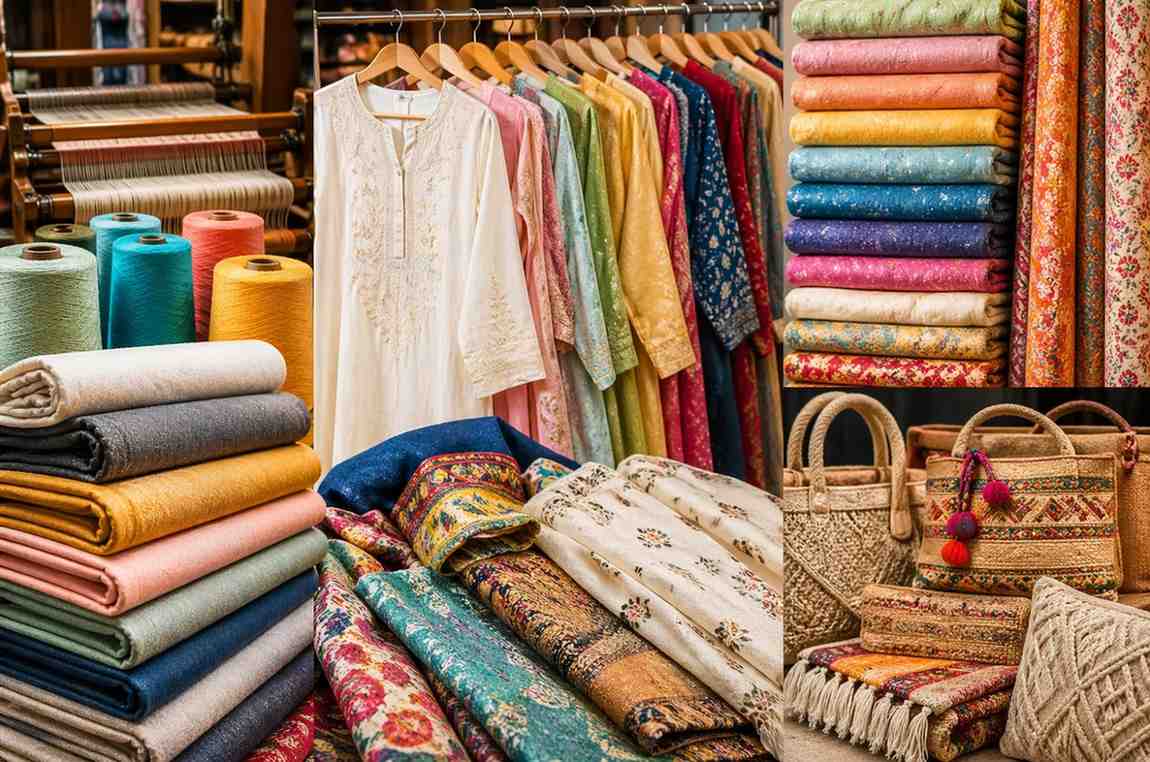
Recovery, recycling and sustainable manufacturing initiatives are helping India’s textile and apparel industry strengthen its global competitiveness while creating millions of livelihoods.
India’s textile and apparel industry, one of the country’s largest manufacturing sectors, is steadily embracing sustainability and circular economy practices as global demand shifts towards environmentally responsible production.
Contributing around 2% to India’s GDP and 11% to manufacturing Gross Value Added (GVA), the sector is also the world’s sixth-largest textile and apparel exporter with a 4% share in global exports. The industry provides direct employment to more than 45 million people, including a significant number of women and rural workers.
As international buyers increasingly prioritise sustainable sourcing, India is leveraging its traditional resource-efficient production systems alongside modern policy interventions to strengthen its competitiveness.
Circular economy reshapes textile value chain
India’s textile value chain has emerged as one of the world’s largest circular ecosystems, with significant progress in recovery, recycling and reuse of textile waste.
The country manages nearly 7.8 million tonnes of textile waste annually, of which more than 90% originates from domestic pre-consumer and post-consumer waste streams. More than 70% of the waste is recovered and diverted towards recycling, upcycling, downcycling or reuse.
Recovery rates are particularly high at the factory level, where nearly 95% of pre-consumer textile waste is collected and reused through established industry networks.
The spinning segment has emerged as one of the strongest examples of circular manufacturing, with almost all spinning waste being reintegrated into production.
India has also built an extensive collection and sorting network for post-consumer textiles, enabling nearly 55% of discarded textiles to be diverted from landfills.
The circular ecosystem supports an estimated 40-45 lakh livelihoods, with women from marginalised communities playing a key role in collection, sorting and redistribution activities.
Navi Mumbai showcases circular textile model
A notable example of circular innovation is India’s first Municipal Textile Recovery Facility in Belapur, Navi Mumbai.
The facility has so far collected 30 metric tonnes of post-consumer textile waste, sorted 25.5 metric tonnes, processed over 41,000 textile items, and developed more than 400 upcycled product samples.
The initiative has reached over 1.14 lakh households while creating livelihood opportunities for women artisans through exhibitions and market access programmes.
Sustainable inputs gain policy support
The sustainability journey begins with raw materials, where the government is encouraging greater adoption of organic fibres and safer production practices.
The National Programme for Organic Production (NPOP) supports certification, accreditation and promotion of organic products, including organic cotton, with standards recognised by the European Commission and Switzerland.
Pilot projects are also promoting safer chemical use and eco-friendly textile manufacturing.
One such initiative, Eliminating Hazardous Chemicals from the Textile Fashion Supply Chain in India’covers 400 factories across eight textile clusters and four fashion houses. The project is expected to mitigate 1,47,000 tonnes of CO₂ equivalent emissions while reducing hazardous chemical usage by 10,530 tonnes.
India has also restricted benzidine-based dyes and prohibited the use of 70 azo dyes, while implementing commitments under the Stockholm Convention to reduce Persistent Organic Pollutants (POPs).
Green manufacturing gathers pace
The manufacturing stage remains central to the industry’s sustainability efforts because of its intensive use of water and energy.
The government’s flagship PM Mega Integrated Textile Region and Apparel (PM MITRA) programme is developing integrated textile manufacturing hubs with sustainability built into their infrastructure.
The parks include Common Effluent Treatment Plants (CETPs), wastewater recycling systems, scientific waste management facilities and shared utilities under the ‘5F’ vision—Farm to Fibre to Factory to Fashion to Foreign.
Seven PM MITRA Parks have been approved with an outlay of ₹4,445 crore through 2027-28 across Tamil Nadu, Telangana, Gujarat, Karnataka, Madhya Pradesh, Uttar Pradesh and Maharashtra.
As of December 2025, the programme had attracted investment commitments worth more than ₹27,434 crore, with land acquisition completed for all seven locations.
MSMEs receive green incentives
With MSMEs accounting for more than 80% of India’s textile and apparel production capacity, the government has introduced dedicated schemes to accelerate sustainable manufacturing.
Under the Raising and Accelerating MSME Performance (RAMP) programme, the MSE-GIFT scheme promotes green technologies through 2% annual interest subvention on loans up to ₹2 crore, along with credit guarantee support.
The MSE-SPICE scheme encourages adoption of circular economy solutions by offering 25% capital subsidy for eligible investments in sustainable plant and machinery.
Carbon market brings new accountability
The textile sector has also been brought under the Indian Carbon Market (ICM) through the Carbon Credit Trading Scheme (CCTS).
Textile companies covered under the mechanism are required to disclose both Scope 1 (direct) and Scope 2 (indirect electricity-related) greenhouse gas emissions.
Companies outperforming their assigned emission intensity targets become eligible to receive Carbon Credit Certificates, which can be traded with entities that fall short of compliance, creating a financial incentive for reducing emissions.
Outlook
With stronger policy support, expanding recycling infrastructure and growing global demand for sustainable products, India’s textile industry is positioning itself to become a global leader in circular manufacturing. The combination of environmental stewardship, resource efficiency and livelihood generation is expected to play an increasingly important role in enhancing the sector’s long-term competitiveness in international markets