

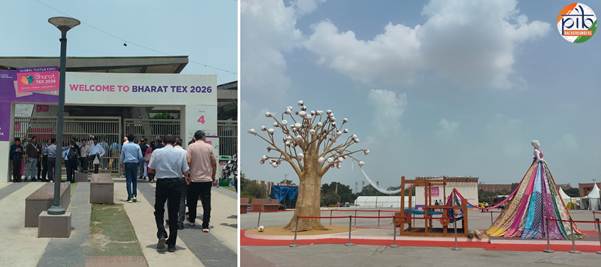
The recently concluded Bharat Tex 2026 has reinforced India’s position as a global textile powerhouse by bringing together traditional artisans, handloom cooperatives, manufacturers, technology innovators and international buyers under one roof, reflecting the country’s ambition to become a leading global sourcing hub.
Guided by the government’s 5F vision, Farm to Fibre to Factory to Fashion to Foreign, the mega textile exhibition showcased the entire textile value chain, spanning fibre, yarn, fabrics, apparel, home textiles, technical textiles, handlooms and handicrafts.
The event attracted more than 6,000 buyers from over 130 countries and welcomed over 1.3 lakh trade visitors. Spread across 1.6 million sq. ft., Bharat Tex 2026 featured more than 20,000 textile products, making it one of the world’s largest textile exhibitions.
Beyond business
While the scale of the exhibition underscored India’s manufacturing capabilities, Bharat Tex also emerged as a platform for preserving traditional crafts, generating livelihoods and connecting local enterprises with global markets.
The exhibition floor reflected the growing convergence of heritage, sustainability, innovation and international commerce, with Indian companies exploring export opportunities while overseas buyers assessed sourcing prospects from India.
Traditional crafts gain global visibility
Jaipur-based Weaves, a sixth-generation textile enterprise, showcased traditional block-printing techniques such as Dabu, Bagru and Batik.
According to Kashyap Kedia, Manager, Weaves, the company works with nearly 200 artisans and produces around 2.5 lakh metres of block-printed fabric annually.
“Of our six printing styles, five can only be produced in India, particularly in Rajasthan, where the climate supports the process,” he said.
Kedia added that live demonstrations at Bharat Tex significantly boosted visitor engagement, attracting potential buyers from countries including Qatar, Sri Lanka and Myanmar.
Bihar’s Tikuli art attracts attention
The exhibition also provided a global platform for Tikuli art, Bihar’s centuries-old folk art known for its vibrant enamel work.
Arundhati Mahato, a Tikuli artist from Patna, said the craft has evolved from decorative forehead ornaments into intricate artwork on wood, textiles and lifestyle products.
With around 25 women receiving free training through her initiative, the art form is also creating flexible livelihood opportunities for women working from home.
Mahato said Bharat Tex has helped introduce the traditional craft to a wider audience of buyers and textile businesses, many of whom were unfamiliar with the art form.
Tribal textiles find modern appeal
Jharkhand-based Johargram highlighted how indigenous tribal textiles can be integrated into contemporary fashion by transforming traditionally woven shawls into shirts, jackets and trench coats.
Pawan Kumar, Creative and Operations Head, said the brand draws inspiration from weaving traditions of the Uraon and Munda communities.
He noted that global demand has enabled the enterprise to engage around 80 weavers, while participation at Bharat Tex has opened new business-to-business opportunities with exporters and international buyers.
Handloom cooperative expands export reach
Kanpur-based Niryaatak Handloom Cooperative Society Limited showcased rugs, carpets and home décor products made from cotton, wool and recycled PET yarn.
The cooperative, comprising around 120 weavers, operates both from its production centre and through home-based weaving.
According to Mohammad Imran, President of the cooperative, Bharat Tex facilitated discussions with buyers from Iraq and Algeria, including companies supplying to European markets.
A subsidised exhibition stall supported by the Handloom Export Promotion Council enabled the cooperative to participate in the event and explore export opportunities.
Circular economy gains momentum
The exhibition also highlighted sustainable textile solutions through companies such as ReFiber, which operates a technology-enabled platform for collecting post-consumer textile waste.
The collected garments are routed to partner NGOs for recycling, while ReFiber facilitates a marketplace for upcycled products.
Manoj Wanvari, Chief Operating Officer, said the company received an encouraging response during its maiden participation, interacting with visitors from Bangladesh, Spain, the United States, Portugal and Sri Lanka.
The company now plans to expand its textile collection network across India while partnering with more organisations engaged in textile reuse and recycling.